Politics
Delta Government Urges Investors TO Leverage Improved Business Environment

By Chantell Ohwofasa
The Delta State Government has called on local and foreign investors to take advantage of ongoing reforms, saying the state is now one of Nigeria’s most attractive destinations for investment.
The call was made during the Delta State Investment Summit stakeholders’ engagement in Asaba, where officials and business leaders discussed strategies for economic growth.
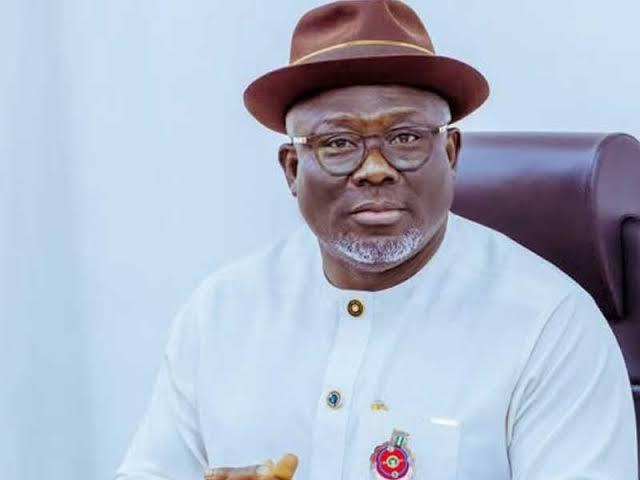
Representing Governor Sheriff Oborevwori, Secretary to the State Government, Sir Fidelis Tilije, said the administration is committed to policies that encourage private sector investment, improve infrastructure, and create jobs.
He noted that the MORE Agenda prioritizes collaboration between government and the private sector.
Executive Assistant to the Governor on Investment Promotion, Anthony Emeka Elekeokwuri, said the government is simplifying business processes and removing bottlenecks.
He identified agriculture, manufacturing, tourism, technology, and small-scale enterprises as key areas of opportunity.
Director-General of the Presidential Enabling Business Environment Council, Princess Zahrah Mustapha Audu, commended Delta for aligning with federal ease-of-doing-business reforms.
Representatives of NACCIMA, MAN, and AFAN also expressed optimism that improved policies would boost investment and productivity.
Analysts said a stable, investor-friendly environment could benefit communities across the state, including Abraka, by supporting entrepreneurship and small businesses.






By Harrenta Brown
As Nigeria celebrates 66 years of independence today, 42 reportedly children taken from a school in Borno State have spent 139 days in captivity.
They were abducted on May 15th 2026 from Mussa Primary and Junior Secondary School in Borno State.
Six weeks later, on June 29, a second attack struck the same local government area.
Gunmen reportedly raided Government Day Secondary School in Lassa about 20 km from Mussa, killing a teacher who refused to go with them and abducting 36 students and one more teacher.
Gunmen struck two schools on May 15th in Oyo State and Borno State.
In Oyo, 39 children and seven teachers were abducted. l
The Oyo case became a viral topic and made news headlines within days, driven by outrage after one of the kidnapped teachers, Mr. Michael Oyedokun, was beheaded. Social media coverage was constant, and 56 days later, on July 10th, the surviving Oyo children and teachers were released.
Many Nigerians are shocked to learn for the first time that these children have been in captivity for that long.
Their shock is followed by a question: How did this happen without them knowing?
For most of the past four and a half months, most Nigerians had no idea they were still in captivity. Interviewed individuals’ reactions have ranged from disbelief to suspicion of a deliberate silence.
Kamsi and his friend Victor both believe the government’s silence is political, as they pointed to next year’s election, saying “the media isn’t talking about it because it reflects badly on the country and on the coming election”.
Judith had no idea the children were still missing.
“It’s evil and heartbreaking that these children are still in captivity while the government remains silent,” she said.
Enor reacted with the same shock, saying she had no idea and called for the government’s transparency, also urging officials to update citizens on the case so the children do not become forgotten the way the Chibok girls were.
Another Nigerian who asked not to be named wondered why a country was celebrating its independence when it truly had no independent security forces.
He asked who was to be blamed and believes that the silence has a regional dimension.
He argued that Northern Nigeria receives less attention than the South, and that the case would have moved faster if influencers and politicians got involved the same way they did with the Oyo case.
Tife, a corper, wondered why there were no press conferences and coverage on the matter, and why it wasn’t being treated with urgency.
She feared she could have been the one taken and forgotten.
The big questions Nigerians are asking now are not only where the children are, but why has the case not generated the same urgency as the Oyo State case?
They also questioned the celebration of independence as a country when children of the country are still in captivity.
Two kidnappings on the same day, but with two entirely different outcomes.
As of today, the two attacks combined have left 78 schoolchildren from the same corner of Borno State in captivity, 42 from Mussa, now at 139 days, and 36 from Lassa, now at 94 days.
Two kidnappings that happened 45 days apart in the same local government area and neither has produced a rescue.
Politics
Nigeria @ 66: Tinubu Declares End of Emergency Reforms, Says Country Has Entered Age of Shared Prosperity
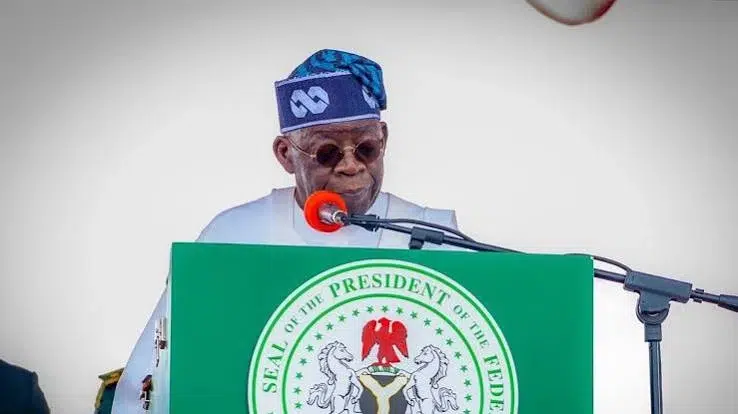
President Bola Ahmed Tinubu, Thursday, declared that Nigeria has passed the worst of its economic pains and has now entered the age of prosperity, in his 66th Independence Day address to the nation.
In an Independence Day celebration broadcast titled “From Reform to Prosperity”, the President said his administration chose to confront Nigeria’s deep economic distortions head-on when it assumed office in 2023, likening the country at that time to a cancer patient who must endure painful treatment to survive.
He said for too long Nigeria’s leaders chose morphine while praying for a miracle that never came, but his administration resolved to do things differently and excise the cancer.
Three and a half years after the removal of fuel subsidy and the foreign exchange reforms, Tinubu said the evidence of recovery is now undeniable.
He noted that the economy has grown by over four percent this year, with both oil and non-oil sectors contributing to stable growth, while oil theft has reduced and foreign direct investment continues to rise.
READ ALSO: Oborevwori, DELSU VC Hail Peretomode at Valedictory Lecture
According to him, inflation has fallen substantially from its peak, foreign reserves have been rebuilt and the foreign exchange market has stabilised.
He added that in 2025 the country recorded its highest revenue from non-oil exports in history, exceeding six billion dollars, which he described as real money being made by real Nigerian businesses.
These, he said, are not idle claims, as international observers, journalists, NGOs and multilateral institutions have all concluded that the reforms have strengthened Nigeria’s stability and resilience.
The President said that with the foundation now repaired, the central task of government has changed from correcting the economy to delivering shared and widespread prosperity.
He explained that prosperity to him does not mean merely larger numbers or better statistics, but a Nigeria where the farmer can cultivate safely and earn a decent return, where factories have reliable power, businesses can obtain credit, young people can find productive work, food and transportation are affordable, education is within reach, and families can look to the future with confidence.
To achieve this, Tinubu said his government will focus on bringing down the cost of living by lowering the cost of producing and moving goods.
He outlined plans to expand mechanised irrigation and dry-season farming, improve access to seeds and fertiliser, increase mechanisation, invest in storage and transportation, and build and complete roads, railways and ports that connect farms and factories to markets.
READ ALSO: Lawyers Advocate Speedy Justice For Litigants In Abraka Courts
His logic, he said, is simple: when farmers produce more cheaply, when fewer crops are lost between farm and market, when manufacturers spend less on electricity and trucks reach destinations faster in a competitive environment, those savings will ultimately reflect in market prices.
On jobs, the President said Nigeria’s youthful population must become an engine of production rather than a source of despair.
He pledged to use the nation’s gas to power new industries, support businesses to revive factories in industrial centres, expand digital connectivity into long-neglected communities, invest in relevant skills and provide infrastructure and finance for businesses to grow.
He said he wants to see more Nigerians making things, more farms feeding cities and supplying factories, more businesses selling Nigerian goods to the world, and young Nigerians building unicorns and creating opportunities at home.
Acknowledging that millions of citizens still struggle for daily meals, school fees and medical bills, the President said their plight is the accumulated consequence of decades of low productivity and weak institutions.
While this cannot be erased in four years, he said the course can be changed and the vulnerable will not be abandoned.
He pointed to strengthened direct support through an improved National Social Register for the poorest households, the Nigerian Education Loan Fund ensuring that children of low-income families can pursue higher education, and CREDICORP giving working Nigerians access to consumer credit for vehicles, solar systems and digital devices without years of savings.
He added that government has continued to pay salaries and pensions on time and in full, reformed the national pension programme, and is working with states and local governments to strengthen primary healthcare and basic education.
These programmes, he said, are not substitutes for prosperity but a bridge towards it, stressing that the objective is not to manage poverty more efficiently but to defeat it.
Tinubu urged Nigerians to resist calls by what he described as influential but regressive voices to abandon reforms and return to addictive subsidies, insisting that the nation must remember why the journey began.
He declared that the emergency treatment is over and the foundation has been repaired, saying Nigeria has corrected its course and passed through its own Red Sea.
While calling for unity and renewed faith, he said the promised land before the nation is one of abundance and opportunity where prosperity is broadly shared and every child can dream beyond the circumstances of birth.
He concluded that the destination is in sight, the foundations are strong and the direction is clear, urging Nigerians to go forward together with no looking back.

A former Vice-Chancellor of Delta State University, Abraka, Prof. Victor Peretomode, has proposed a tripartite governance model to sustain excellence in the institution.
Peretomode proposed the model at DELSU’s 12th valedictory lecture held on Thursday, September 24, 2026, at the university’s 750 Lecture Theatre, Site III.
The lecture was titled, “DELSU and the Burden of Expectation: The Challenges of Being Delta State’s Premier University and Rethinking Governance for Sustainable Excellence.”
He said as the state’s premier university, DELSU carries triple burdens — aspirational, political and operational — which translate into expectations such as expanding access to university education for Deltans, accommodating qualified indigenes, advancing state-specific development priorities and producing morally sound and employable graduates.
READ ALSO: DELSU Exam Monitors Apprehend Student With Allegedly Stolen Phones, Wig
Peretomode, a Professor of Educational Administration and Higher Education, said the challenges could be addressed through his proposed “Peretomode Tripartite Model of Governance for Sustainable Excellence,” anchored on three pillars: Leadership Integrity, Funding Predictability and Quality Assurance.
He observed that DELSU has come far, but its journey is far from complete, adding that the burden of expectation it carries is not a weight to be feared, but a responsibility to be fulfilled.
In his remarks, Governor Sheriff Oborevwori, Visitor to the university, described Peretomode as an academic who contributed immensely to the development of university education in the state.
Oborevwori, who was represented by the Commissioner for Higher Education, Prof. Nyerhovwo Tonukari, said the state would still need Peretomode’s wealth of experience as he bows out of service and assured of continued support for DELSU.
On his part, the Vice-Chancellor of DELSU, Prof. Samuel Asagba, lauded Peretomode’s achievements as former VC, noting that his policies, though considered harsh at the time, have placed the university in its present enviable state.
Asagba wished the valedictory lecturer the best in his future endeavours.
Highlights of the event included the launch of two books authored by the valedictory lecturer and a musical rendition by the Department of Music.
Peretomode joined DELSU in 1992 as Senior Lecturer in the Department of Educational Management and Foundations, became a Professor in 1996 and served as its 7th substantive Vice-Chancellor from 2014 to 2019.
The lecture was attended by the Vice-Chancellor of University of Delta, Agbor, Prof. Eric Eboh, Vice-Chancellor of Southern Delta University, Ozoro, Prof. Sunny Awhefeada, DELSU Deputy Vice-Chancellor (Administration), Prof. Edmund Atakpo, DELSU Deputy Vice Chancellor (Academic), Prof. Hilary Owamah, DELSU Deputy Vice-Chancellor (Research and Innovation), Prof. Douglasson Omotor, Deputy Vice-Chancellor, University of Delta, Agbor, Prof. Patrick Ijeh, Provost of Oleh Campus, Prof. Augustine Atonuje, DELSU Registrar, Mrs Rufina Ufiofio, DELSU Bursar, Mrs Otimeyin Ekakitie-Omajuwa, DELSU Librarian, Dr Josephine Onohwakpor, Provosts, Deans, Directors, staff and students of the university.
Also in attendance were the Rector of Delta State Polytechnic, Otefe-Oghara, Prof. Emmanuel Ufuophu-Biri, Rector, Delta State Marine Polytechnic, Burutu, Prof. Emmanuel Okoro, Delta business tycoon, Chief Tunde Smooth, Executive Director of Project, DESOPADEC, Chief (Dr) Ebenezer Okorodudu, former DELSU Governing Council Chairman, Prof. Sam Oyovbaire, former Dennis Osadebey University Governing Council Chairman, Prof. Robert Ikomi, members of DELSU College of Chaplains, friends and family members of the valedictory lecturer, including his wife, Dr (Mrs) Otaroghene Peretomode.
The release comes barely 24 hours after the state-owned institution released its first batch of admission for the incoming session.
-
 Education2 months ago
Breaking: DELSU Postpones Second Semester Examinations. See New Date
-
 Education3 months ago
DELSU Announces Admission Into New Diploma Programmes For 2026/2027 Academic Session
-
 Views Point3 months ago
OPINION: Agriculture, Nigeria’s Fading Goldmine
-

 Abraka Metro3 months ago
Experts Urge Students To Embrace AI With Open Hearts
-

 Education2 months ago
Breaking: DELSU Bans “Sign Out” Parties, Threatens 2-Semester Rustication For Violators
-

 Education3 months ago
28-Years-Old Man Swindles JUPEB Students, Diverts N15 Million School Fees
-
 Education2 months ago
DELSU Begins Postgraduate Admission for 2026/2027 Academic Session
-

 Entertainment3 months ago
World Cup 2026: US-Iran Tensions, Local Travel Hurdles, Global Friction Shape Fan Atmosphere
-

 Abraka Metro3 months ago
Rising Cost Of Living Forces Abraka Students To Adopt Survival Strategies
-
 Abraka Metro3 months ago
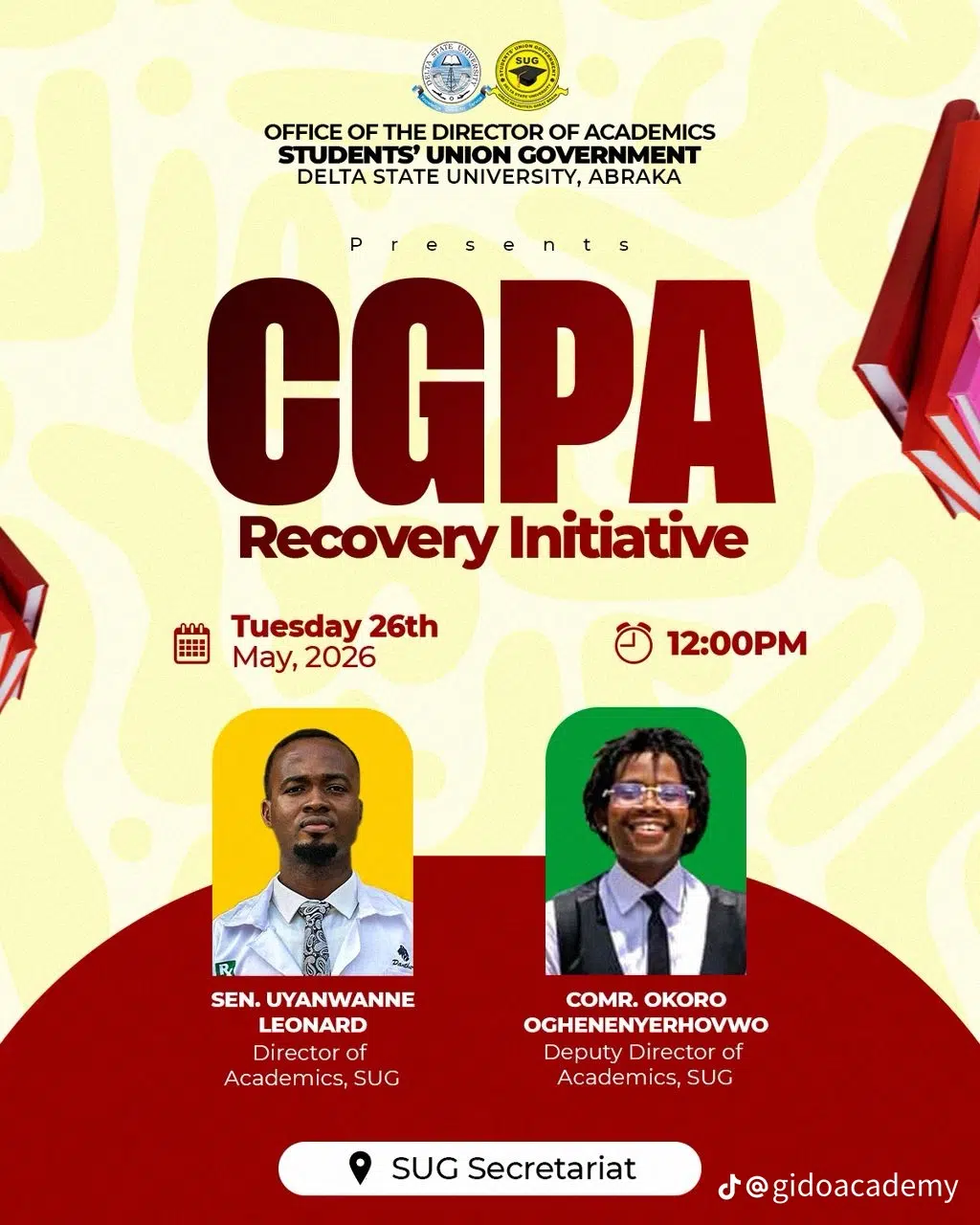
DELSU SUG Tackles Academic Decline with ‘CGPA Recovery Initiative’ for Junior Students
-

 Education2 months ago
DELSU Exam Monitors Apprehend Student With Allegedly Stolen Phones, Wig
-
 Abraka Metro3 months ago
Rising House Rents Put Pressure on DELSU Students in Abraka
-

 Abraka Metro2 months ago
Elozino Ogege: Lecturers React As Court Sentences Killers Of DELSU First-Class Student To Death
-
 Education3 months ago
Challenges Persist at DELSU Agricultural Farm Despite Student Training
-
 Trending News3 months ago
Abraka Residents Advocate Entrepreneurship, Warn Against Gambling Amid Economic Hardship


