Politics
Delta Assembly Declares Udu Constituency Seat Vacant Over Defection


By Chetachi Egbu
The Delta State House of Assembly has declared the seat of the lawmaker representing Udu State Constituency, Hon. Collins Egbetamah, vacant following his defection from the political party on whose platform he was elected.
The decision was reached during plenary on Tuesday, presided over by the Speaker of the House, Rt. Hon. Emomotimi Dennis Guwor. Members of the Assembly unanimously adopted a motion moved by the Majority Leader, Hon. Emeka Nwaobi, and seconded by the Deputy Speaker, Rt. Hon. Arthur Akpowowo.
In his ruling, Speaker Guwor said the action was taken in line with Section 109(1)(g) and (2) of the 1999 Constitution of the Federal Republic of Nigeria (as amended), which states that a member of a State House of Assembly shall vacate his seat if he defects from the political party that sponsored his election, except where such defection is caused by a division within the party or a merger involving political parties.
The Speaker explained that the House reviewed the lawmaker’s notification letter on his defection and found no evidence of any internal division within the party that could justify his continued occupation of the seat.
“Having satisfied the constitutional requirements, this Honourable House hereby declares the seat of the Honourable Member representing Udu State Constituency vacant with immediate effect,” Guwor ruled.
Following the declaration, the Speaker directed the Clerk of the House to notify the Independent National Electoral Commission (INEC) to begin the process of conducting a bye-election to fill the vacant position.
The development has generated political reactions across Delta State, with supporters of the lawmaker’s new political party faulting the decision. They described the declaration as unconstitutional and politically motivated, arguing that the matter should be determined by a competent court.
Former Deputy President of the Senate, Senator Ovie Omo-Agege, also criticised the Assembly’s action, stating that the constitutional provision relating to division within political parties should have been properly considered before declaring the seat vacant.
However, the House maintained that its decision was based strictly on constitutional provisions. Majority Leader Emeka Nwaobi said no evidence of a genuine division within the party was presented to warrant an exemption under the law.
Legal observers noted that any challenge to the Assembly’s decision would ultimately be determined by the courts, adding that previous cases involving legislative defections have depended on judicial interpretations of constitutional provisions.
Political analysts say the development could influence political activities in Delta State in the coming weeks as stakeholders await INEC’s response on the proposed bye-election and possible legal actions arising from the declaration.








By Unity Enofomi
The Delta State House of Assembly has unanimously approved a proposed constitutional amendment seeking to establish state police services in the state while retaining the Nigeria Police Force as the federal police service.
The proposal was approved during plenary on Tuesday, October 20, 2026, with 23 lawmakers voting in favour. The development marks a significant step in the ongoing efforts to strengthen security and improve the protection of lives and property across Delta State.
The lawmakers said the establishment of state police could improve local intelligence gathering, enable faster responses to security threats and strengthen the fight against crime. They expressed the view that a policing system with greater local involvement could help security agencies respond more effectively to challenges within communities.
Following the approval, the Speaker of the House, Emomotimi Guwor, directed the Clerk to communicate the Assembly’s resolution to the National Assembly for further legislative action. The proposal will require additional legislative and constitutional procedures before state police can be established and become operational.
READ ALSO: ISGN Congratulates Oyowe on Re-election as Delta NUJ Chairman
The move has renewed discussions about the potential benefits and challenges of state policing in Nigeria. Supporters believe it could improve security by bringing policing closer to local communities, while concerns remain about funding, accountability and the possible misuse of state police by political officeholders.
The Delta State House of Assembly’s approval represents an important step towards the proposed establishment of state police in the state. However, the success of the initiative will depend on the completion of the required constitutional process, adequate funding and effective oversight. If implemented with appropriate safeguards, state policing could strengthen local security efforts and contribute to the protection of lives and property across Delta State.
In a public noticed obtained by Media Conversation, the university said the initiative is designed to provide an alternative pathway for candidates seeking admission into their courses of choice without waiting endlessly for JAMB

The Ibori Suenu Grassroots Network (ISGN) has congratulated Comrade Churchill Oyowe on his re-election as Chairman of the Nigeria Union of Journalists (NUJ), Delta State Council.
Oyowe was re-elected for another three-year term following a keenly contested election held at the Union’s state headquarters on October 15, 2026.
In a congratulatory statement jointly signed by its National Chairman, Chief Andrew Majemite, and Director of Media, Chief Ofa Henry Ogheneochuko, the group said Churchill’s re-election was a reflection of his performance in his first tenure.
According to ISGN, the Oyowe-led administration laid a solid foundation for the growth of the Union through achievements in financial accountability, infrastructure development, welfare and professional training.
READ ALSO: Delta’s HIV Cases Rise Above 51,000, ACOMIN Demands Urgent Intervention
The group cited the settlement of outstanding rent owed to the Union’s former landlord before relocation to its permanent secretariat, improvement of the NUJ Press Centre, prompt payment of secretariat staff salaries, and regular payment of State Working Committee (SWC) sitting allowances.
It also listed the successful organization of the 2024 and 2025 NUJ Press Week, which attracted commendation from the national body and the public, and the strategic coordination that led to the emergence of two Delta delegates as Vice President and Zonal Secretary of the National Association of Women Journalists (NAWOJ) in November 2023.
ISGN described as a landmark achievement the creation of two new chapels in 2024 – Oasis Magazine Chapel and Fresh Angle International Chapel – which increased the number of chapels in the state to 18.
Recounting a personal experience, the group said its Media Director had visited the NUJ Chairman in the early months of his first tenure over an outstanding financial obligation owed to him as the Union’s former landlord.
“The Chairman displayed humility, an accommodating disposition and made a firm commitment to address the matter, which he fulfilled within a remarkably short period. That encounter gave us early conviction in his capacity to lead,” the statement noted.
The group said it was not surprised by his re-election, attributing it to his open-door leadership style and accessibility.
While praying for wisdom, strength and good health for the Chairman in his new tenure, ISGN urged him to extend a hand of fellowship to his fellow contestants in the election.
“Leadership is not only about winning an election; it is also about building bridges, strengthening institutions, and creating opportunities for collective progress. Their ideas and experiences could prove mutually beneficial to the Union,” the group stated.
ISGN reaffirmed its commitment to highlighting developmental initiatives of APC-led governments across the country in the areas of infrastructure, education, healthcare, economic growth and youth empowerment.
Organised by the Department of English and Literary Studies, the event is themed “Passing the Torch: The Enduring Legacies of Late Prof. Simon Obikpeko Umukoro.”

By Harrenta Brown
As Nigeria celebrates 66 years of independence today, 42 reportedly children taken from a school in Borno State have spent 139 days in captivity.
They were abducted on May 15th 2026 from Mussa Primary and Junior Secondary School in Borno State.
Six weeks later, on June 29, a second attack struck the same local government area.
Gunmen reportedly raided Government Day Secondary School in Lassa about 20 km from Mussa, killing a teacher who refused to go with them and abducting 36 students and one more teacher.
Gunmen struck two schools on May 15th in Oyo State and Borno State.
In Oyo, 39 children and seven teachers were abducted. l
The Oyo case became a viral topic and made news headlines within days, driven by outrage after one of the kidnapped teachers, Mr. Michael Oyedokun, was beheaded. Social media coverage was constant, and 56 days later, on July 10th, the surviving Oyo children and teachers were released.
Many Nigerians are shocked to learn for the first time that these children have been in captivity for that long.
Their shock is followed by a question: How did this happen without them knowing?
For most of the past four and a half months, most Nigerians had no idea they were still in captivity. Interviewed individuals’ reactions have ranged from disbelief to suspicion of a deliberate silence.
Kamsi and his friend Victor both believe the government’s silence is political, as they pointed to next year’s election, saying “the media isn’t talking about it because it reflects badly on the country and on the coming election”.
Judith had no idea the children were still missing.
“It’s evil and heartbreaking that these children are still in captivity while the government remains silent,” she said.
Enor reacted with the same shock, saying she had no idea and called for the government’s transparency, also urging officials to update citizens on the case so the children do not become forgotten the way the Chibok girls were.
Another Nigerian who asked not to be named wondered why a country was celebrating its independence when it truly had no independent security forces.
He asked who was to be blamed and believes that the silence has a regional dimension.
He argued that Northern Nigeria receives less attention than the South, and that the case would have moved faster if influencers and politicians got involved the same way they did with the Oyo case.
Tife, a corper, wondered why there were no press conferences and coverage on the matter, and why it wasn’t being treated with urgency.
She feared she could have been the one taken and forgotten.
The big questions Nigerians are asking now are not only where the children are, but why has the case not generated the same urgency as the Oyo State case?
They also questioned the celebration of independence as a country when children of the country are still in captivity.
Two kidnappings on the same day, but with two entirely different outcomes.
As of today, the two attacks combined have left 78 schoolchildren from the same corner of Borno State in captivity, 42 from Mussa, now at 139 days, and 36 from Lassa, now at 94 days.
Two kidnappings that happened 45 days apart in the same local government area and neither has produced a rescue.
-

 Education4 months ago
Breaking: DELSU Postpones Second Semester Examinations. See New Date
-

 Education4 months ago
DELSU Announces Admission Into New Diploma Programmes For 2026/2027 Academic Session
-

 Views Point5 months ago
OPINION: Agriculture, Nigeria’s Fading Goldmine
-

 Abraka Metro5 months ago
Experts Urge Students To Embrace AI With Open Hearts
-

 Education4 months ago
Breaking: DELSU Bans “Sign Out” Parties, Threatens 2-Semester Rustication For Violators
-

 Education4 months ago
DELSU Begins Postgraduate Admission for 2026/2027 Academic Session
-

 Education5 months ago
28-Years-Old Man Swindles JUPEB Students, Diverts N15 Million School Fees
-

 Entertainment4 months ago
World Cup 2026: US-Iran Tensions, Local Travel Hurdles, Global Friction Shape Fan Atmosphere
-

 Education3 months ago
DELSU Exam Monitors Apprehend Student With Allegedly Stolen Phones, Wig
-
 Education4 months ago
Challenges Persist at DELSU Agricultural Farm Despite Student Training
-

 Abraka Metro4 months ago
Rising Cost Of Living Forces Abraka Students To Adopt Survival Strategies
-
 Abraka Metro5 months ago
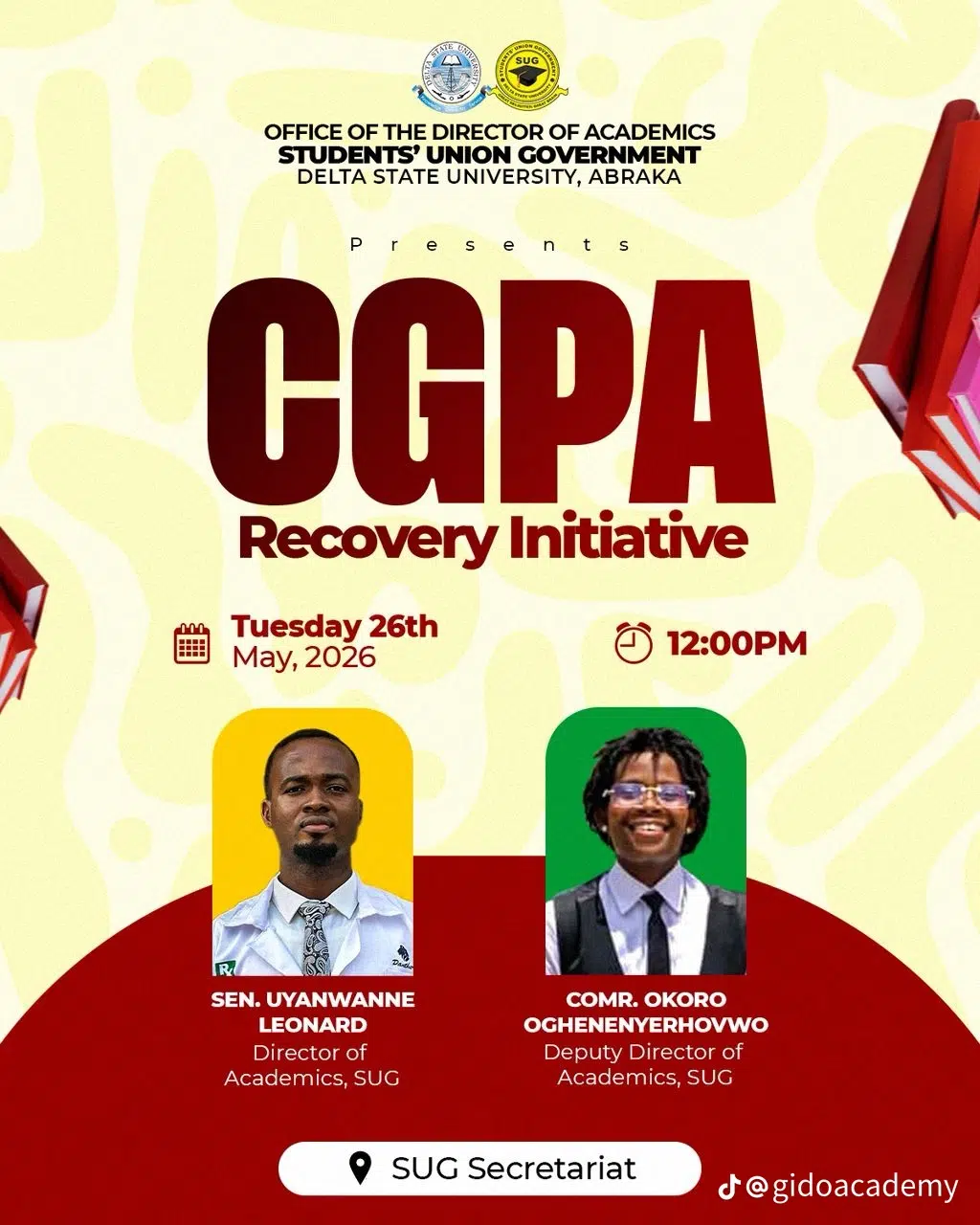
DELSU SUG Tackles Academic Decline with ‘CGPA Recovery Initiative’ for Junior Students
-
 Abraka Metro4 months ago
Rising House Rents Put Pressure on DELSU Students in Abraka
-

 Trending News4 months ago
Abraka Residents Advocate Entrepreneurship, Warn Against Gambling Amid Economic Hardship
-

 Abraka Metro4 months ago
Elozino Ogege: Lecturers React As Court Sentences Killers Of DELSU First-Class Student To Death


