
Entertainment
Eco Hostel Students Steal The Spotlight As Gender Switch Day Turns Campus 2 Into A Fashion Runway

By Eyeolusan Sigmund
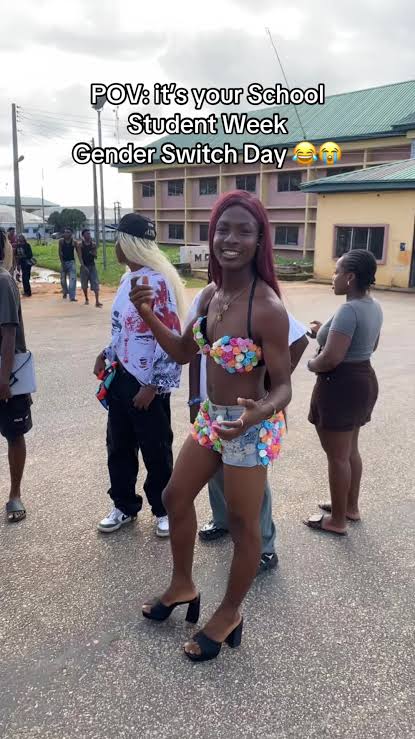
What began as a fun hostel activity quickly became one of the most talked-about fashion moments on Campus 2 of Delta State University, Abraka, as students of Eco Hostel transformed themselves during the highly anticipated Gender Switch Day.
The event drew dozens of students from different hostels and departments, all eager to witness the creativity on display.
Throughout the day, the hostel premises buzzed with excitement as male students appeared dressed in outfits traditionally worn by women, while female students confidently stepped out in styles typically associated with men.
The fashion showcase from neatly tailored suits and oversized shirts to flowing gowns, wigs, handbags, makeup, sneakers, ties and sunglasses, the event showcased a remarkable blend of fashion, confidence and entertainment.
Laughter filled the atmosphere as students admired one another’s transformations, took photographs, recorded videos and shared the experience across social media platforms.
Unlike an ordinary costume event, Gender Switch Day encouraged participants to experiment with fashion in a light-hearted and respectful manner.
Many students spent days planning their outfits, borrowing accessories from friends and perfecting their appearance before stepping outside their hostel rooms.
Some male students wore carefully styled wigs, long acrylic nails, handbags and fashionable dresses that made them almost unrecognizable.
Others walked gracefully in sandals while attempting to imitate feminine mannerisms, drawing cheers and laughter from spectators.
Female students were equally impressive.
Dressed in oversized jeans, corporate trousers, sneakers, face caps, wristwatches and button-up shirts, many adopted confident masculine poses while interacting with fellow students.
Some even wore fake beards and sunglasses, completing the illusion.
For several hours, Eco Hostel resembled a fashion exhibition rather than a regular student residence.
Small groups gathered around participants, complimenting their creativity and comparing outfits.
Phones remained constantly raised as students documented the colourful event.
Speaking during the programme, one of the student coordinators, Victory Edeh, explained that the activity was designed mainly to promote friendship and entertainment within the hostel community.
“We wanted everyone to have fun and forget academic stress for a while. Fashion is a way of expressing creativity, and Gender Switch Day gave students the opportunity to do something different without judging anyone.
“The turnout exceeded our expectations.”
One of the participants, Michael Oghenekaro, who appeared in a floral gown, makeup and a shoulder-length wig, admitted that he was nervous before stepping outside.
“At first, I thought people would laugh at me, but when everyone started cheering and taking pictures, I became more confident. It was actually enjoyable.
“I never imagined I would wear makeup, but today was all about having fun.”
Another participant, Precious Ejiro, who dressed in a complete male outfit with a tie, trousers and polished shoes, said the experience made her appreciate the simplicity of men’s fashion.
“Walking like a guy was easier than I expected, but maintaining the serious facial expression wasn’t easy because everyone kept making jokes.
“It was an exciting experience, and I would definitely participate again.”
A 300-level student of Mass Communication, Blessing Akpojotor, who attended as a spectator, said the event demonstrated the creativity that exists among students.
“What impressed me most was the attention to detail.
“Some people looked completely different from their normal appearance. You could tell they invested time and effort into preparing their outfits.”
Another observer, Daniel Omovie, described the programme as one of the most entertaining hostel activities he had witnessed this semester.
“Everywhere you looked, people were smiling and taking pictures. It wasn’t just about dressing differently; it created conversations and brought students together.”
Fashion enthusiast Mercy Ofobuku, who also watched the event, praised participants for their confidence.
“Fashion is about confidence, and that’s exactly what we saw today. Some outfits were funny, while others were surprisingly stylish.
“It shows that young people are becoming more creative with fashion.”
One participant, Samuel Oborewori, who appeared wearing a fitted skirt, matching blouse and handbag, said preparing for the event took longer than expected.
“Borrowing clothes wasn’t difficult, but learning how to wear them properly was another challenge. My friends helped with the makeup and accessories.
“Looking at the final result, I think it was worth the effort.”
Similarly, Jennifer Oghenewede, dressed in a three-piece suit with neatly combed hair and a necktie, explained that she wanted to portray the confidence often associated with men’s fashion.
“I wanted people to see that fashion has no limits when it comes to creativity. Everyone interpreted the theme differently, and that made the event more interesting.”
Students continued taking photographs long after the main activities had ended.
Music played from portable speakers while participants posed in groups, exchanged compliments and celebrated the successful event that brought the campus community together through creativity and fashion.





By Favour Ojotomobor
A new game introduced into Nigeria in early October 2026, called ‘Lagos Life’, is taking the country by storm. The game allows people, whether they live in Lagos or not, to experience what it feels like to live in Lagos. A young student living in Abraka, Delta State, claims she was gifted over a billion Naira in the game.
The game was developed by a young Nigerian software developer, Ijeoma Shalom Rayhamen. It is a free, web browser-based life-simulation game that mirrors the socio-economic realities, humour, and chaos of living in Lagos. It is widely described by players as the ‘Naija version of The Sims’.
The game grew organically, skyrocketing from 100,000 users to over 1 million players within just a matter of days.
In ‘Lagos Life’, there are two different classes: ‘Nepo Baby’ (born into wealth and privilege) and ‘Lapo Baby’ (born into micro-financial loans and starting life with extreme financial hustle). To survive and thrive, players must balance money, energy, work, and leisure. ‘Lapo’ babies have to quickly find jobs to earn in-game cash.
Unlike traditional games, Lagos Life requires no app download. It runs entirely within a mobile or desktop web browser, eliminating data barriers for Nigerian gamers. Instead of relying on aggressive in-app purchases, the creator cleverly monetised the intense traffic by selling space on virtual billboards inside the game to real-world brands, yielding over $46,000 in its first four days alone.
READ ALSO: NANS Begs As Madonna University Expels Nursing Students Over Viral Hospital Video
Due to the game’s massive success, the developer has already announced plans to scale the universe. New features linked to the game include AbujaLife and PHLife (Port Harcourt).
During an interview, a young student named Victory Agidah said that in the game she has cars and houses that she bought with her money from the game.
Another player named Pedro said the game is all about fun, the money cannot be withdrawn, it is like living in the real world where you talk to people who can easily gift you money and some beg for money as well. There have been cases where some people asked if it is possible to be credited to their OPay. A popular TikTok celebrity, Peller, credited a young boy with N500,000 cash after the boy was generous enough to send him some of his in-game money when Peller complained on X (Twitter) about how low his money was in the game.
Lagos Life Game has turned many Nigerians into addicted gamers. Pedro says it helps some people who are depressed to be distracted from overthinking and enjoy life in Lagos. Hopefully, it continues to favour the youth.

In Nigeria’s entertainment history, few female musicians have left a legacy as enduring as Christy Essien-Igbokwe.
Her success as a singer, actress and music administrator made her one of the pioneers who transformed the country’s music industry.
Born in Akwa Ibom State, Christy discovered her passion for music at an early age and steadily built a successful career that produced numerous hit songs and award-winning albums.
Her performances in different Nigerian languages enabled her to connect with audiences from diverse cultural backgrounds.
Apart from entertaining millions of fans, she used her influence to advocate for women and children through music and film.
Her emergence as the first female president of PMAN also demonstrated her leadership and commitment to the growth of Nigeria’s entertainment industry.
Today, years after her passing, Christy Essien-Igbokwe’s songs remain popular, while her achievements continue to inspire upcoming artists.
Her life stands as proof that talent, hard work and determination can create a legacy that outlives generations.
Entertainment
“They Were touching Me Everywhere”: Lady Alleges Gang Assault In Delta Community Festival, Begs For Police Action


By Annabella Esiri/David Akpovwa
A young lady has gone public with allegations that she was assaulted and nearly gang-raped by a group of men in Otor-Iyeded community in Isoko North Local Government Area of Delta State, during a local festival.
In a video shared on TikTok under the handle @dge_redoii, the lady, who appeared distressed and was speaking from what she said was a hospital, recounted that the incident occurred on the day she went out to get kegs for her business in Ugele.
According to her account, she entered a commercial motorcycle to Otor-Iyede, which she identified as her father’s village.
She alleged that upon arrival, a group of more than 20 men surrounded her.
“I was minding my business and then about four immediately dragged me out and dragging my hair, using stick to beat me,” she said in the video.
She further alleged that the men touched her inappropriately and attempted to take her to a hotel.
The woman said she was rescued after calling her mother, who then contacted relatives.
She stated that her uncles and the police were alerted and she was taken to her uncle’s house.
She expressed frustration over the response she received from community members, alleging that she was told “this is the tradition” and that “they are not going to do anything.”
“I don’t have evidence because I could not video it… but they should do something about it,” she said, appealing for authorities to investigate.
As of the time of filing this report, the Delta State Police Command has not released an official statement on the allegation.
Efforts to reach community leaders in Otor-Iyede for comment were ongoing.
Human rights advocates have urged the police to investigate the claims thoroughly and ensure the safety of the alleged victim.
The video has since sparked reactions online, with many calling for justice and protection for women and girls during cultural festivals.
Editor’s Note: The allegations in this report are based on the account given by the individual in a public video. Delta State University, Abraka, and other authorities have not yet confirmed the details. Victims of sexual assault are advised to seek medical attention and report to the nearest police station or support organizations.
If you or someone you know has experienced sexual violence, you can contact the Nigeria Police Force, NAPTIP, or local support centers for assistance.
-

 Education4 months ago
Breaking: DELSU Postpones Second Semester Examinations. See New Date
-

 Education4 months ago
DELSU Announces Admission Into New Diploma Programmes For 2026/2027 Academic Session
-
 Views Point5 months ago
OPINION: Agriculture, Nigeria’s Fading Goldmine
-

 Abraka Metro5 months ago
Experts Urge Students To Embrace AI With Open Hearts
-

 Education4 months ago
Breaking: DELSU Bans “Sign Out” Parties, Threatens 2-Semester Rustication For Violators
-
 Education4 months ago
DELSU Begins Postgraduate Admission for 2026/2027 Academic Session
-

 Education5 months ago
28-Years-Old Man Swindles JUPEB Students, Diverts N15 Million School Fees
-

 Entertainment4 months ago
World Cup 2026: US-Iran Tensions, Local Travel Hurdles, Global Friction Shape Fan Atmosphere
-

 Education3 months ago
DELSU Exam Monitors Apprehend Student With Allegedly Stolen Phones, Wig
-
 Education4 months ago
Challenges Persist at DELSU Agricultural Farm Despite Student Training
-

 Abraka Metro4 months ago
Rising Cost Of Living Forces Abraka Students To Adopt Survival Strategies
-
 Abraka Metro5 months ago
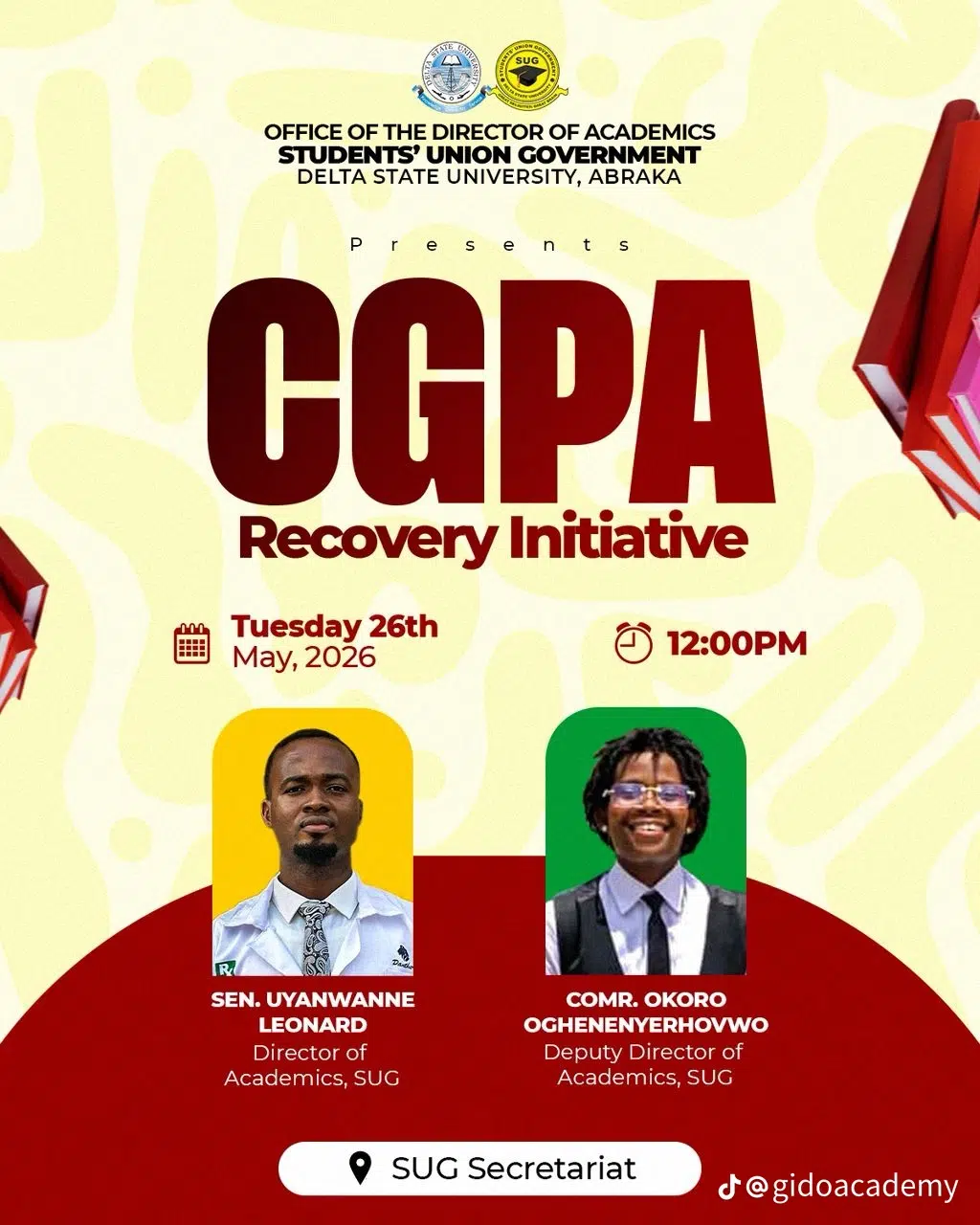
DELSU SUG Tackles Academic Decline with ‘CGPA Recovery Initiative’ for Junior Students
-
 Abraka Metro4 months ago
Rising House Rents Put Pressure on DELSU Students in Abraka
-

 Trending News4 months ago
Abraka Residents Advocate Entrepreneurship, Warn Against Gambling Amid Economic Hardship
-

 Abraka Metro4 months ago
Elozino Ogege: Lecturers React As Court Sentences Killers Of DELSU First-Class Student To Death


