Entertainment
The Scroll Generation And Nollywood, By Precious Enusa

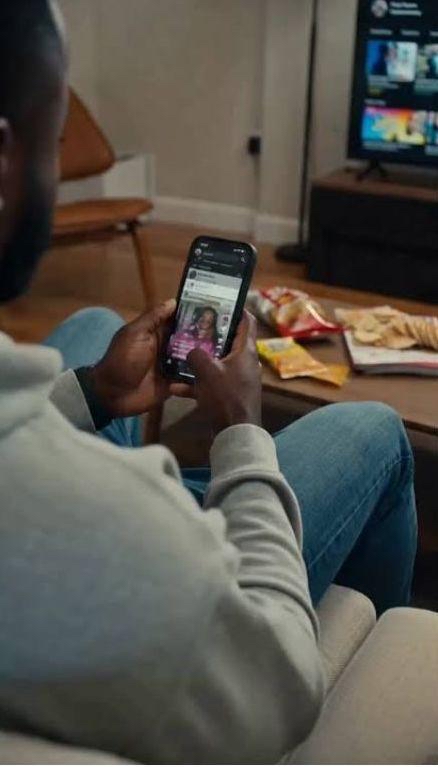
I recently tried to watch a Nollywood film with a friend. Barely four minutes had passed before he reached for his phone.”When is something going to happen?” he asked. I laughed because, truthfully, I had been thinking the same thing. A few seconds later, he skipped ahead, then a little further, then abandoned the film altogether for TikTok, where he spent the next forty minutes watching clips that lasted less than a minute each. The irony wasn’t lost on either of us. Somehow, we had become too impatient for a two-hour story but had endless patience for hundreds of disconnected thirty-second clips.
That moment stayed with me. Yet I remember a different era. Growing up, watching Papa Ajasco, Super Story or Soul Sisters was rarely a solitary experience. Siblings wandered into sitting rooms when they heard the familiar theme songs. Families gathered around one television. Nobody was asking for the story to hurry up. Nobody was complaining that “nothing has happened yet.” The conversations came after the credits rolled, not while everyone was distracted by another screen.
Today, that kind of patience feels almost nostalgic. It is tempting to blame TikTok, Instagram Reels or YouTube Shorts for this shift. They certainly deserve part of the conversation. Their endless streams of bite-sized content have trained us to expect instant gratification. Every swipe promises something newer, funnier or more exciting than the last. The moment boredom creeps in, another video is waiting.
But the real story is bigger than social media. We now live in what economists and media scholars call the attention economy, a world where attention has become one of the most valuable commodities. Every app wants it. Every notification competes for it. Every creator measures success by how long they can hold onto it. In this economy, time is no longer just money; attention is.
The consequences are measurable. Gloria Mark, a professor at the University of California, Irvine, has spent more than two decades studying human attention. Her research shows that the average time people stay focused on a single screen activity has fallen dramatically over the years. Once our attention is interrupted, regaining deep focus can take far longer than most people realise.
Nollywood has not escaped this reality. For an industry built on long-form storytelling, that changes everything. Perhaps no one understood this better than Funke Akindele. Long before “Everybody Loves Jenifa” reached cinemas, audiences had already been seeing the film everywhere, not through conventional trailers, but through dance videos, comedy skits, behind-the-scenes clips and social media reels released months in advance. By the time the film finally premiered, it already felt familiar. People were not simply buying cinema tickets; they were completing a conversation they had been part of online for months. The strategy worked. The film crossed the billion-naira mark at the Nigerian box office, proving that in today’s entertainment landscape, attention is often won long before release day.
READ ALSO: Opinion: Social media: A Learning Tool Or A Distraction?
The payoff shows in the numbers. By mid-2026, Nigerian films had overtaken Hollywood’s share of the local box office for the first time in years, according to the Cinema Exhibitors Association of Nigeria and FilmOne Entertainment, despite fewer titles released overall. Nigerian cinema attendance is now above pre-pandemic levels even as Hollywood ticket sales in the same market have dropped by nearly two-thirds. The films doing the heavy lifting are comedies rooted in everyday Nigerian life- exactly the register skit culture spent a decade perfecting.
The transformation goes beyond marketing. A decade ago, aspiring actors hoped to be discovered through auditions. Today, many first build an audience on social media.
Take Broda Shaggi. Before becoming a familiar face in mainstream Nollywood, he built an enormous following through short comedy skits. Those sixty-second performances became his portfolio, introducing him to millions long before any casting director called. Along the way, he collaborated with established actors, creating a bridge between the internet and the film industry. In many ways, the skit has quietly become the new audition.
This is one of the most fascinating shifts in Nigerian entertainment. Rather than treating skit makers as competitors, Nollywood has absorbed them. The timing, humour and cultural references perfected in short-form comedy now influence everything from casting decisions to screenplay pacing and film promotion.
However, adaptation always comes with trade-offs. For years, one of the biggest criticisms of Nollywood was that some films took too long to get to the point. Scenes lingered, conversations repeated themselves and plots sometimes moved at a frustrating pace. In many ways, today’s audiences have forced filmmakers to become more disciplined. scenes that overstayed their welcome. But something is also slipping away. It’s hard to imagine many younger viewers today sitting through the unhurried openings that made Super Story or Osuofia in London so memorable, not because those stories were poorly told, but because our viewing habits have changed.
But there is a difference between better pacing and perpetual speed. Some of Nollywood’s most enduring stories became memorable because they allowed emotions to unfold naturally.Those stories trusted viewers to stay.
READ ALSO: Police Arrest Driver for Kidnapping Child He Was Hired to Transport
Today’s filmmakers often cannot afford that luxury. They are competing not just with other films, but with TikTok, Instagram Reels, football highlights, podcasts, memes and countless other distractions living inside the same smartphone.
Still, I hesitate to claim that people can no longer concentrate. If that were true, cinemas would not still fill up for the right films. People would not binge entire television series in a weekend. Football fans would not remain glued to ninety minutes of action every week. Nigerians would not spend hours following election coverage or reality television like Big Brother Naija when the stakes feel high enough. Attention hasn’t disappeared. It has become expensive. We no longer give it away freely, stories have to earn it.
For Nollywood, that is both a challenge and an opportunity.The future of Nigerian cinema will not be decided by whether films become faster or slower. It will be decided by whether they can still make audiences care deeply enough to put their phones down.
Because in a world built on endless scrolling, perhaps the greatest achievement for any filmmaker is no longer making people watch. It is making them stay.
Precious Enusa is a final year student of Mass Communication at Delta State University, Abraka.








By Favour Ojotomobor
A new game introduced into Nigeria in early October 2026, called ‘Lagos Life’, is taking the country by storm. The game allows people, whether they live in Lagos or not, to experience what it feels like to live in Lagos. A young student living in Abraka, Delta State, claims she was gifted over a billion Naira in the game.
The game was developed by a young Nigerian software developer, Ijeoma Shalom Rayhamen. It is a free, web browser-based life-simulation game that mirrors the socio-economic realities, humour, and chaos of living in Lagos. It is widely described by players as the ‘Naija version of The Sims’.
The game grew organically, skyrocketing from 100,000 users to over 1 million players within just a matter of days.
In ‘Lagos Life’, there are two different classes: ‘Nepo Baby’ (born into wealth and privilege) and ‘Lapo Baby’ (born into micro-financial loans and starting life with extreme financial hustle). To survive and thrive, players must balance money, energy, work, and leisure. ‘Lapo’ babies have to quickly find jobs to earn in-game cash.
Unlike traditional games, Lagos Life requires no app download. It runs entirely within a mobile or desktop web browser, eliminating data barriers for Nigerian gamers. Instead of relying on aggressive in-app purchases, the creator cleverly monetised the intense traffic by selling space on virtual billboards inside the game to real-world brands, yielding over $46,000 in its first four days alone.
READ ALSO: NANS Begs As Madonna University Expels Nursing Students Over Viral Hospital Video
Due to the game’s massive success, the developer has already announced plans to scale the universe. New features linked to the game include AbujaLife and PHLife (Port Harcourt).
During an interview, a young student named Victory Agidah said that in the game she has cars and houses that she bought with her money from the game.
Another player named Pedro said the game is all about fun, the money cannot be withdrawn, it is like living in the real world where you talk to people who can easily gift you money and some beg for money as well. There have been cases where some people asked if it is possible to be credited to their OPay. A popular TikTok celebrity, Peller, credited a young boy with N500,000 cash after the boy was generous enough to send him some of his in-game money when Peller complained on X (Twitter) about how low his money was in the game.
Lagos Life Game has turned many Nigerians into addicted gamers. Pedro says it helps some people who are depressed to be distracted from overthinking and enjoy life in Lagos. Hopefully, it continues to favour the youth.


In Nigeria’s entertainment history, few female musicians have left a legacy as enduring as Christy Essien-Igbokwe.
Her success as a singer, actress and music administrator made her one of the pioneers who transformed the country’s music industry.
Born in Akwa Ibom State, Christy discovered her passion for music at an early age and steadily built a successful career that produced numerous hit songs and award-winning albums.
Her performances in different Nigerian languages enabled her to connect with audiences from diverse cultural backgrounds.
Apart from entertaining millions of fans, she used her influence to advocate for women and children through music and film.
Her emergence as the first female president of PMAN also demonstrated her leadership and commitment to the growth of Nigeria’s entertainment industry.
Today, years after her passing, Christy Essien-Igbokwe’s songs remain popular, while her achievements continue to inspire upcoming artists.
Her life stands as proof that talent, hard work and determination can create a legacy that outlives generations.
Entertainment
“They Were touching Me Everywhere”: Lady Alleges Gang Assault In Delta Community Festival, Begs For Police Action

By Annabella Esiri/David Akpovwa
A young lady has gone public with allegations that she was assaulted and nearly gang-raped by a group of men in Otor-Iyeded community in Isoko North Local Government Area of Delta State, during a local festival.
In a video shared on TikTok under the handle @dge_redoii, the lady, who appeared distressed and was speaking from what she said was a hospital, recounted that the incident occurred on the day she went out to get kegs for her business in Ugele.
According to her account, she entered a commercial motorcycle to Otor-Iyede, which she identified as her father’s village.
She alleged that upon arrival, a group of more than 20 men surrounded her.
“I was minding my business and then about four immediately dragged me out and dragging my hair, using stick to beat me,” she said in the video.
She further alleged that the men touched her inappropriately and attempted to take her to a hotel.
The woman said she was rescued after calling her mother, who then contacted relatives.
She stated that her uncles and the police were alerted and she was taken to her uncle’s house.
She expressed frustration over the response she received from community members, alleging that she was told “this is the tradition” and that “they are not going to do anything.”
“I don’t have evidence because I could not video it… but they should do something about it,” she said, appealing for authorities to investigate.
As of the time of filing this report, the Delta State Police Command has not released an official statement on the allegation.
Efforts to reach community leaders in Otor-Iyede for comment were ongoing.
Human rights advocates have urged the police to investigate the claims thoroughly and ensure the safety of the alleged victim.
The video has since sparked reactions online, with many calling for justice and protection for women and girls during cultural festivals.
Editor’s Note: The allegations in this report are based on the account given by the individual in a public video. Delta State University, Abraka, and other authorities have not yet confirmed the details. Victims of sexual assault are advised to seek medical attention and report to the nearest police station or support organizations.
If you or someone you know has experienced sexual violence, you can contact the Nigeria Police Force, NAPTIP, or local support centers for assistance.
-

 Education4 months ago
Breaking: DELSU Postpones Second Semester Examinations. See New Date
-

 Education4 months ago
DELSU Announces Admission Into New Diploma Programmes For 2026/2027 Academic Session
-

 Views Point5 months ago
OPINION: Agriculture, Nigeria’s Fading Goldmine
-

 Abraka Metro5 months ago
Experts Urge Students To Embrace AI With Open Hearts
-

 Education4 months ago
Breaking: DELSU Bans “Sign Out” Parties, Threatens 2-Semester Rustication For Violators
-

 Education4 months ago
DELSU Begins Postgraduate Admission for 2026/2027 Academic Session
-

 Education5 months ago
28-Years-Old Man Swindles JUPEB Students, Diverts N15 Million School Fees
-

 Entertainment4 months ago
World Cup 2026: US-Iran Tensions, Local Travel Hurdles, Global Friction Shape Fan Atmosphere
-

 Education3 months ago
DELSU Exam Monitors Apprehend Student With Allegedly Stolen Phones, Wig
-

 Education4 months ago
Challenges Persist at DELSU Agricultural Farm Despite Student Training
-

 Abraka Metro4 months ago
Rising Cost Of Living Forces Abraka Students To Adopt Survival Strategies
-
 Abraka Metro5 months ago
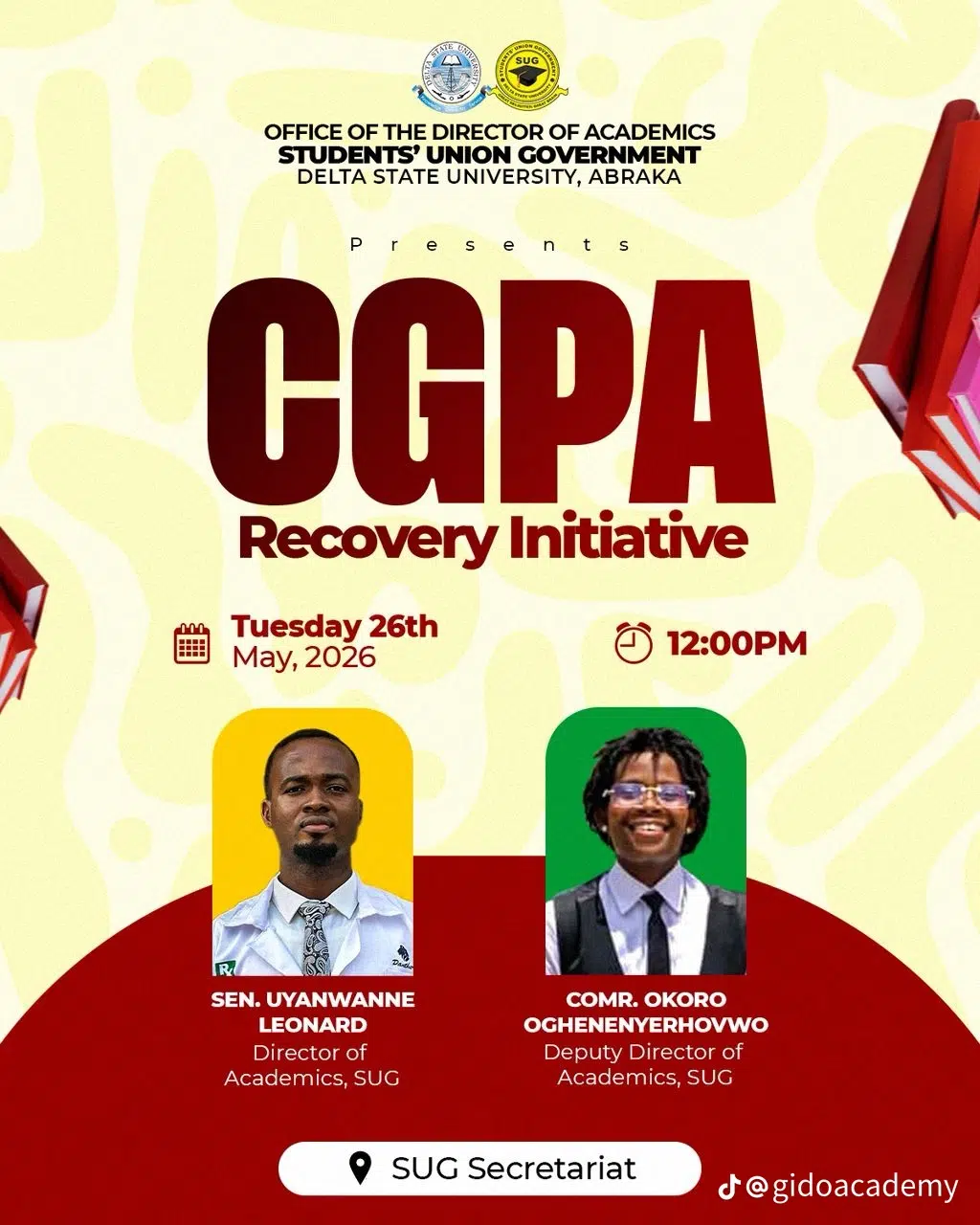
DELSU SUG Tackles Academic Decline with ‘CGPA Recovery Initiative’ for Junior Students
-

 Abraka Metro4 months ago
Rising House Rents Put Pressure on DELSU Students in Abraka
-

 Trending News4 months ago
Abraka Residents Advocate Entrepreneurship, Warn Against Gambling Amid Economic Hardship
-

 Abraka Metro4 months ago
Elozino Ogege: Lecturers React As Court Sentences Killers Of DELSU First-Class Student To Death


