Trending News
Doubts, Criticisms Trail Tinubu’s Acclaimed 10 Million Votes Amid Nigeria’s Rising Voter Apathy


BY EFE ETUATIMI TOTOH
As the Nigerian 2027 general elections approach, incumbent President Bola Tinubu’s 10.99 million votes in the All Progressives Congress (APC) presidential primary on May 20, 2026, have sparked sharp criticism and widespread disbelief.
Critics argue that the results sharply contrast with Nigeria’s historic voter apathy during the 2023 general elections, which saw a record-low turnout of just 27%, making it the lowest since 1999.
Expectedly, leading opposition parties have called this figure and unbelievable concoction that doesn’t reflect political reality and warned it could signal rigging ahead of 2027.
Former Vice President and presidential candidate of the African Democratic Congress (ADC) disagrees with claims that Tinubu secured 10 million votes during the primaries, describing the figures as fabricated.
Media Conversation reports that Tinubu won the 2023 presidential election with 8.8 million votes, representing less than 10% of the 93.5 million registered voters. This indicates that only a small fraction of the population actively chose him.
Analysts had reported that the 2023 general elections saw an abstention rate of 73%.
Nigeria’s voter apathy is mainly driven by distrust in the Independent National Electoral Commission (INEC), fears of violence at polling stations, concerns about the integrity of votes, and a consistent decline in voter turnout over successive elections.
Commenting on the issue, Hon. Cletus Obum, an APC leader, told newsmen that “Tinubu’s 10 million votes fell short of our expectations.”
Similarly, a Special Adviser to the Governor of Delta State on Student Affairs, Mr. Anthony Okeoghene, insisted that the over 10 million votes garnered by the president is a show that more Nigerians are in the party.
He further stressed that “it’s a tale of political dominance, looking at the numbers of state governors that are in the ruling party. Out of the 36 states, we have over 30 governors in APC, meaning the governors and the members of their cabinet are in the party.
The APC claims over 10 million supporters in a single party primary, yet the country’s overall electoral participation remains critically low, with less than 5% of the total population. Unmet promises contributes largely to voter apathy in Nigeria and creates a disconnect between campaign promises and participation. As former presidential aide Olusegun Adeniyi noted: “The democracy we practice does not impact enough Nigerians to make them care about voting.”
Nigeria’s voter apathy crisis extends beyond primary election controversy.
In December 2025, INEC Chairman, Prof. Joash Amupitan stressed that technology alone cannot solve Nigeria’s persistent voter apathy.
Despite the commission’s introduction of Biometric Voter Verification System (BVAS) and Internal Results Viewing (IREV) portal, voter participation has declined steadily since peaking at 69% in 2003, dropping sharply to just 27% in 2023, the lowest in Nigeria’s democratic history.
Pro-democracy activists warn against repeating the 2023 scenario where fewer than nine million decisive voters chose the president.
Dr. Otive Igbuzor, Executive Director of the African Centre for Leadership, Strategy and Development, decried that “it’s unfortunate that such a small percentage determined the winner.”
Whether 2027 will break this cycle remains Nigeria’s most pressing democratic question.
In an interview with Media Conversation, Ms. Christabel Agevafo, the founder of the initiative, explained that HOS was established to create a safe space where women can participate in sports, develop fitness routines, and enhance their overall well-being.











A Run and Rave event sponsored by Soft Nigeria in Warri, Delta State, was interrupted on Thursday after some participants protested against polo shirts bearing the image of President Bola Ahmed Tinubu.
The event, held at PTI Junction as part of activities marking Nigeria’s Independence Day, attracted young people who gathered for the fitness and entertainment programme.
According to videos and reports from the scene, some participants objected after shirts bearing Tinubu’s image were distributed. Some were seen tearing the shirts, while others chanted the name of Peter Obi and shouted, “We no go wear.”
Edema Seun, a young man who attended the Run and Rave event, said he encountered supporters of Peter Obi on his way to the venue but decided to remain at the event.
“I met the Obi supporters on the way and I stayed back to enjoy the event I came for. Later on I heard that there were burning shirts,” Seun said.
Seun’s account indicates that he did not personally witness the reported burning of the shirts, but learnt about it later during the event.
Videos circulating online showed some participants tearing the shirts, while others gathered around the area where the disagreement occurred. The available footage does not establish the political affiliation of all the participants or indicate that everyone at the event took part in the protest.
The incident has since attracted attention on social media, with reactions focusing on the use of a political figure’s image at an event presented as a fitness and entertainment programme.
The development comes amid increased political activity ahead of Nigeria’s 2027 general election, with supporters of different political figures increasingly visible at public gatherings and community events.
As of the time of filing this report, no detailed statement from Soft Nigeria explaining the distribution of the Tinubu-branded shirts or responding to the incident had been identified.
The Run and Rave event itself was organised as a fitness and entertainment gathering, while the political disagreement emerged during the programme over the shirts distributed to participants.
Politics
Nigeria @ 66: Tinubu Declares End of Emergency Reforms, Says Country Has Entered Age of Shared Prosperity
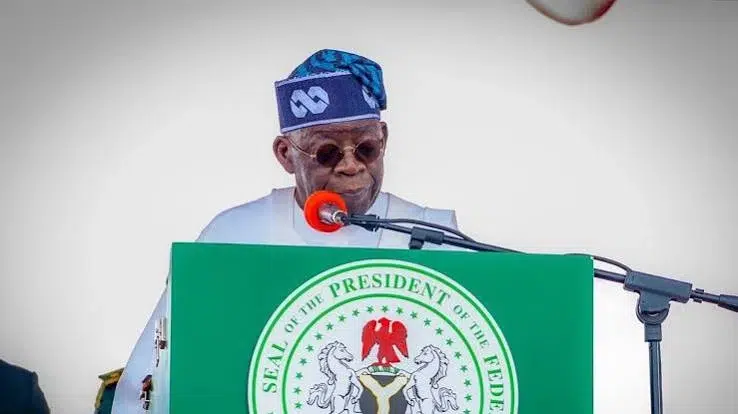
President Bola Ahmed Tinubu, Thursday, declared that Nigeria has passed the worst of its economic pains and has now entered the age of prosperity, in his 66th Independence Day address to the nation.
In an Independence Day celebration broadcast titled “From Reform to Prosperity”, the President said his administration chose to confront Nigeria’s deep economic distortions head-on when it assumed office in 2023, likening the country at that time to a cancer patient who must endure painful treatment to survive.
He said for too long Nigeria’s leaders chose morphine while praying for a miracle that never came, but his administration resolved to do things differently and excise the cancer.
Three and a half years after the removal of fuel subsidy and the foreign exchange reforms, Tinubu said the evidence of recovery is now undeniable.
He noted that the economy has grown by over four percent this year, with both oil and non-oil sectors contributing to stable growth, while oil theft has reduced and foreign direct investment continues to rise.
READ ALSO: Oborevwori, DELSU VC Hail Peretomode at Valedictory Lecture
According to him, inflation has fallen substantially from its peak, foreign reserves have been rebuilt and the foreign exchange market has stabilised.
He added that in 2025 the country recorded its highest revenue from non-oil exports in history, exceeding six billion dollars, which he described as real money being made by real Nigerian businesses.
These, he said, are not idle claims, as international observers, journalists, NGOs and multilateral institutions have all concluded that the reforms have strengthened Nigeria’s stability and resilience.
The President said that with the foundation now repaired, the central task of government has changed from correcting the economy to delivering shared and widespread prosperity.
He explained that prosperity to him does not mean merely larger numbers or better statistics, but a Nigeria where the farmer can cultivate safely and earn a decent return, where factories have reliable power, businesses can obtain credit, young people can find productive work, food and transportation are affordable, education is within reach, and families can look to the future with confidence.
To achieve this, Tinubu said his government will focus on bringing down the cost of living by lowering the cost of producing and moving goods.
He outlined plans to expand mechanised irrigation and dry-season farming, improve access to seeds and fertiliser, increase mechanisation, invest in storage and transportation, and build and complete roads, railways and ports that connect farms and factories to markets.
READ ALSO: Lawyers Advocate Speedy Justice For Litigants In Abraka Courts
His logic, he said, is simple: when farmers produce more cheaply, when fewer crops are lost between farm and market, when manufacturers spend less on electricity and trucks reach destinations faster in a competitive environment, those savings will ultimately reflect in market prices.
On jobs, the President said Nigeria’s youthful population must become an engine of production rather than a source of despair.
He pledged to use the nation’s gas to power new industries, support businesses to revive factories in industrial centres, expand digital connectivity into long-neglected communities, invest in relevant skills and provide infrastructure and finance for businesses to grow.
He said he wants to see more Nigerians making things, more farms feeding cities and supplying factories, more businesses selling Nigerian goods to the world, and young Nigerians building unicorns and creating opportunities at home.
Acknowledging that millions of citizens still struggle for daily meals, school fees and medical bills, the President said their plight is the accumulated consequence of decades of low productivity and weak institutions.
While this cannot be erased in four years, he said the course can be changed and the vulnerable will not be abandoned.
He pointed to strengthened direct support through an improved National Social Register for the poorest households, the Nigerian Education Loan Fund ensuring that children of low-income families can pursue higher education, and CREDICORP giving working Nigerians access to consumer credit for vehicles, solar systems and digital devices without years of savings.
He added that government has continued to pay salaries and pensions on time and in full, reformed the national pension programme, and is working with states and local governments to strengthen primary healthcare and basic education.
These programmes, he said, are not substitutes for prosperity but a bridge towards it, stressing that the objective is not to manage poverty more efficiently but to defeat it.
Tinubu urged Nigerians to resist calls by what he described as influential but regressive voices to abandon reforms and return to addictive subsidies, insisting that the nation must remember why the journey began.
He declared that the emergency treatment is over and the foundation has been repaired, saying Nigeria has corrected its course and passed through its own Red Sea.
While calling for unity and renewed faith, he said the promised land before the nation is one of abundance and opportunity where prosperity is broadly shared and every child can dream beyond the circumstances of birth.
He concluded that the destination is in sight, the foundations are strong and the direction is clear, urging Nigerians to go forward together with no looking back.
Education
DELSU Sets 77.3 as Highest Cut-Off Mark for 2026/2027, As Clinical Medicine Leads Admission Race

Delta State University, Abraka has released its approved UTME cut-off marks for the 2026/2027 admission session.
The release comes barely 24 hours after the state-owned institution released its first batch of admission for the incoming session.
The announcement, released on Wednesday, 9th September 2026 by the Public Relations Unit of the Directorate of Ceremonials, Information and Public Relations, spells out the minimum scores candidates must attain across the university’s 16 faculties to qualify for admission.
Leading the pack is the Faculty of Clinical Medicine, where Clinical Science carries the highest cut-off of 77.3.
This is closely followed by other health and professional courses that remain the most competitive in the university.
Nursing Science requires 71.2, while Law is set at 70.5. Both Dentistry and Pharmacy also stand at 70.0.
The story is different in several other faculties where the baseline cut-off remains at 40.
This applies to most programmes in the Faculties of Agriculture, Education, Environmental Sciences, and Social Sciences.
In the Faculty of Allied Health Sciences, candidates seeking admission into Medical Laboratory Science will need 65.3, while Pharmacology is pegged at 53.8 and Public Health at 50.
Candidates seeking admission into Engineering courses will have to meet varied benchmarks with Mechanical Engineering having the highest in the faculty at 52.5, followed by Petroleum Engineering at 51.5 and Electrical/Electronic Engineering at 50.5.
Chemical Engineering and Civil Engineering are lower at 45 and 42.9 respectively.
For management-related courses, Accounting leads with 56.7, Business Administration at 55.1, and Public Administration at 52.
In the Faculty of Communication and Media Studies, Mass Communication requires 55.7, while other programmes such as Advertising, Broadcasting, Journalism and Public Relations are at 40.
The Faculty of Computing also sets Computer Science at 56.5, with Cyber Security, Software Engineering, Information Technology and related courses pegged at 40.
In the Faculty of Arts, Theatre Arts and History & International Studies require 50 and 50.6 respectively, while English, French, Music,
Linguistics and Fine Arts are at 40. The Faculty of Science places Microbiology at 50 and Biochemistry at 48.2, with Physics, Chemistry, Mathematics, Geology and other courses at 40.
According to the university’s official bulletin dated Wednesday, 2nd September 2026, the new clearance process will be carried out entirely through the student’s portal.
-

 Education2 months ago
Breaking: DELSU Postpones Second Semester Examinations. See New Date
-
 Education3 months ago
DELSU Announces Admission Into New Diploma Programmes For 2026/2027 Academic Session
-
 Views Point3 months ago
OPINION: Agriculture, Nigeria’s Fading Goldmine
-

 Abraka Metro3 months ago
Experts Urge Students To Embrace AI With Open Hearts
-

 Education2 months ago
Breaking: DELSU Bans “Sign Out” Parties, Threatens 2-Semester Rustication For Violators
-

 Education3 months ago
28-Years-Old Man Swindles JUPEB Students, Diverts N15 Million School Fees
-
 Education2 months ago
DELSU Begins Postgraduate Admission for 2026/2027 Academic Session
-

 Entertainment3 months ago
World Cup 2026: US-Iran Tensions, Local Travel Hurdles, Global Friction Shape Fan Atmosphere
-
 Abraka Metro3 months ago
DELSU SUG Tackles Academic Decline with ‘CGPA Recovery Initiative’ for Junior Students
-

 Abraka Metro3 months ago
Rising Cost Of Living Forces Abraka Students To Adopt Survival Strategies
-

 Education2 months ago
DELSU Exam Monitors Apprehend Student With Allegedly Stolen Phones, Wig
-
 Abraka Metro3 months ago
Rising House Rents Put Pressure on DELSU Students in Abraka
-

 Abraka Metro2 months ago
Elozino Ogege: Lecturers React As Court Sentences Killers Of DELSU First-Class Student To Death
-
 Education3 months ago
Challenges Persist at DELSU Agricultural Farm Despite Student Training
-

 Trending News3 months ago
Abraka Residents Advocate Entrepreneurship, Warn Against Gambling Amid Economic Hardship


