
Education
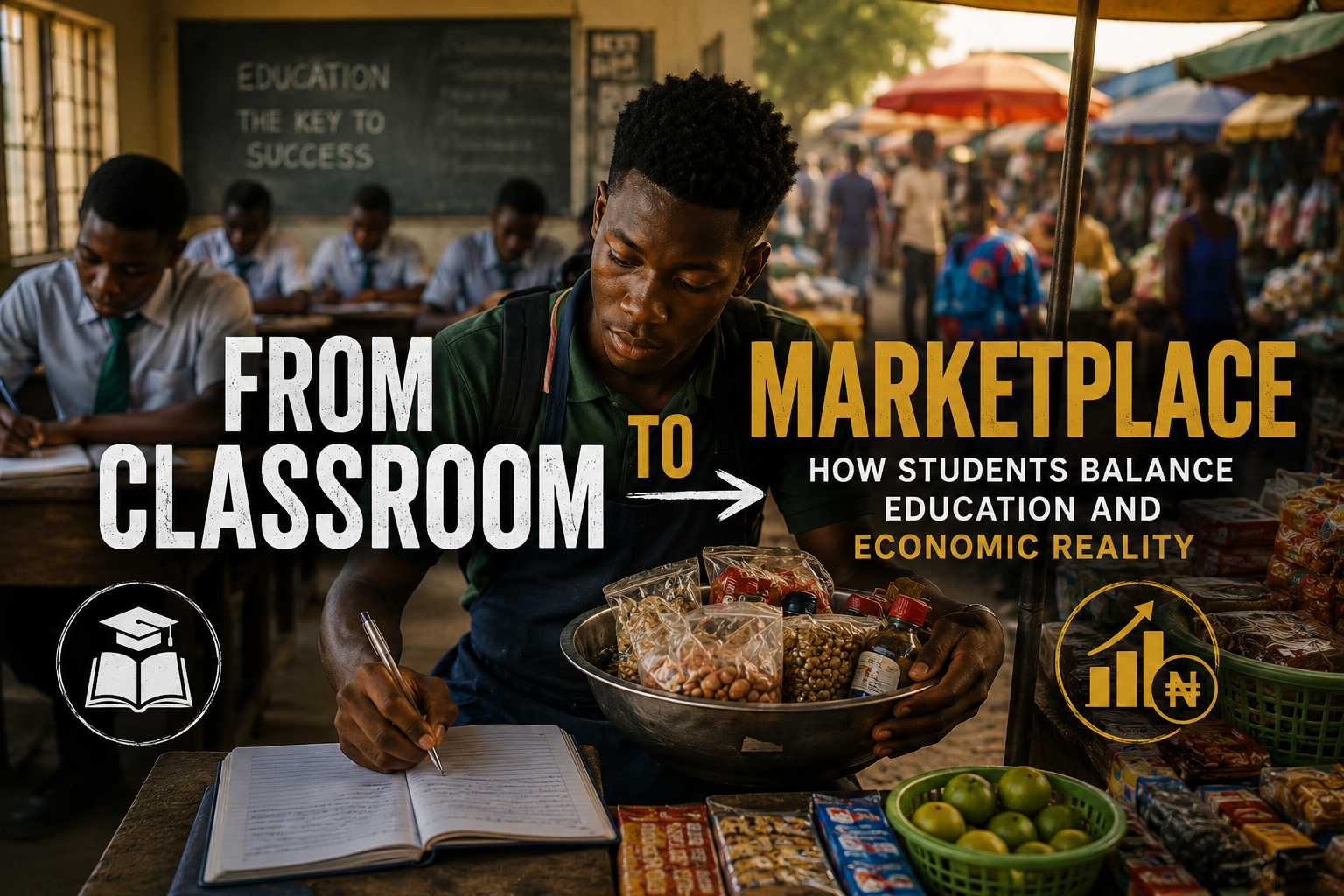
From Classroom to Marketplace:How Students Balancing Education and Economic Reality

By Pius Ashima
“When the stream dries up, the fish must learn to survive in the mud.” This old saying mirrors the reality of many students today. In an economy where the cost of living rises faster than family incomes, young people are discovering that earning a degree is no longer their only challenge, survival itself has become part of the curriculum.
At dawn, while some students prepare for lectures, others are already arranging deliveries, responding to customers, baking pastries, designing graphics, or advertising products online. Their classrooms may be filled with lectures and assignments, but their minds are often occupied with sales targets, transportation costs, and the next source of income.
For many students, the journey through higher education is no longer a straight path from lecture halls to graduation. It is a daily balancing act between academic ambition and economic reality. Faced with rising tuition-related expenses, inflation, and increasing financial pressure on families, students are transforming themselves into entrepreneurs, freelancers, and part-time workers, all while pursuing their degrees.
What was once considered an option has now become a necessity. Across campuses, the marketplace has become an extension of the classroom, where lessons in economics, resilience, and survival are learned firsthand.
The image of the average student has changed significantly over the years. Gone are the days when most students depended entirely on allowances from parents or guardians. Today, many students have become business owners, content creators, tutors, fashion vendors, photographers, hairstylists, and digital freelancers.
A walk through many university campuses reveals a thriving informal economy. Hostel corridors double as mini-shops. Social media platforms serve as virtual marketplaces where students advertise everything from clothing and cosmetics to food and academic services.
For many, these ventures are not driven by a desire for luxury but by necessity. Rising transportation costs, expensive textbooks, accommodation fees, internet subscriptions, and feeding expenses have made it increasingly difficult for students to depend solely on family support.
Twenty-one-year-old Esther, a Mass Communication student, runs an online fashion business alongside her studies.
“My parents try their best, but things are not easy,” she says. “The money they send cannot cover all my needs. Selling clothes helps me pay for handouts, internet data, and other expenses.”
Like Esther, thousands of students across the country have entered the world of entrepreneurship not because they planned to, but because economic realities have left them with few alternatives.
Balancing academics with business activities is often easier said than done. For many students, each day is carefully planned around lecture schedules and customer demands. A lecture may be interrupted by calls from clients. Study sessions are often followed by product deliveries or online consultations. Some students spend their evenings attending to customers and their nights preparing for examinations.
The challenge becomes even greater during examination periods.
Michael, an Economics student who operates a small graphic design business, explains the pressure.
“There are days when I have three assignments to submit, clients waiting for designs, and tests coming up. Sometimes I barely sleep because I am trying to meet every deadline.”
Such experiences have become common among student entrepreneurs. The struggle to balance two demanding responsibilities often leads to physical exhaustion and emotional stress. Yet many students continue because they view their businesses not merely as a source of income but as a lifeline.
Interestingly, many students argue that their economic activities have taught them lessons that cannot be found in textbooks. Running a business requires communication skills, financial discipline, customer management, negotiation, marketing strategies, and problem solving abilities. These practical experiences often complement theoretical knowledge gained in the classroom.
Students who sell products learn the principles of profit and loss firsthand. Freelancers develop professional communication skills. Digital entrepreneurs gain valuable experience in branding and marketing. In many ways, the marketplace has become another classroom, one without lecturers, examinations, or certificates, but rich in practical lessons.
For some students, these experiences have already begun shaping their future careers. What starts as a small side hustle to survive university often grows into a successful business capable of providing employment opportunities after graduation.
Despite the benefits, balancing education and economic activities comes at a cost. Many students admit that juggling both responsibilities can be mentally and physically draining. Long hours of work leave little time for rest. Academic performance may suffer when business demands become overwhelming.
The pressure of constantly worrying about finances can also affect mental health. Students often find themselves struggling with anxiety, stress, and burnout.
“I am always thinking about money,” says Grace, a final year student. “If it’s not school fees, it’s rent. If it’s not rent, it’s feeding or transportation. Sometimes it feels like there is no room to breathe.”
The emotional burden is often intensified by the fear of failure. Students worry about failing academically while simultaneously fearing that their businesses may not generate enough income to meet their needs. This constant balancing act creates a unique form of pressure that many young people face in silence.
The growing trend of student entrepreneurship also reflects the broader economic challenges facing families. Many parents who once comfortably funded their children’s education are now struggling with rising living costs. Inflation has reduced purchasing power, making it increasingly difficult to provide adequate support.
As a result, students are stepping in to bridge the financial gap. Some contribute to their own school expenses, while others support siblings and even assist their parents financially. In some households, students have become important contributors to family income. This shift demonstrates how economic challenges affect not only individuals but entire families.
Although economic hardship has created difficulties, it has also encouraged innovation and resilience among young people. Students are increasingly embracing technology to create opportunities for themselves. Social media platforms have become powerful tools for business promotion, while digital skills such as graphic design, video editing, content creation, and programming offer new income streams.
The ability to adapt to changing circumstances has become one of the defining characteristics of today’s students. Many have learned to identify opportunities where others see obstacles. Through determination and creativity, they continue to pursue their educational goals despite financial challenges.
While students have demonstrated remarkable resilience, many observers believe they should not carry the burden alone. Educational institutions, government agencies, and private organizations all have important roles to play in supporting students. Scholarship opportunities, affordable accommodation, entrepreneurial grants, student-friendly loan programs, and flexible work-study arrangements can help reduce financial pressure.
Providing students with access to mentorship, business training, and mental health support can also improve their ability to balance academic and economic responsibilities effectively. Investing in students is ultimately an investment in the future workforce and economic development of the nation.
The journey from classroom to marketplace tells a powerful story about the realities of modern student life. It is a story of determination in the face of hardship, ambition in the midst of uncertainty, and resilience under pressure.
Today’s students are no longer learning only from textbooks and lectures. They are learning from customers, markets, budgets, and real world challenges. Every sale completed, every service rendered, and every obstacle overcome becomes part of an education that extends far beyond the walls of the classroom.
As economic realities continue to reshape higher education, students remain determined to achieve their dreams. They carry backpacks filled with books and minds filled with business plans. They attend lectures during the day and run enterprises by night.
For this generation, success is no longer measured solely by academic achievement. It is measured by the ability to survive, adapt, and thrive in a world where the classroom and the marketplace have become inseparable parts of the same journey.






By David Amogbokpa
The management of Madonna University, Elele, Rivers State, has reportedly expelled some nursing students involved in a viral social media video recorded in a hospital environment.
The video, which circulated widely online, showed the students dancing and engaging in a TikTok trend with the tag “No fall sick oo, na Gen Z full hospital.”
The incident attracted criticism over concerns about professional conduct and the standards expected of nursing students.
The National Association of Nigerian Students (NANS), while acknowledging that the students’ conduct was inappropriate, has appealed to the university management to reconsider the expulsion.
READ ALSO: DELSU Exam Monitors Apprehend Student With Allegedly Stolen Phones, Wig
In a statement issued by its President, Akinteye Babatunde Afeez, on Friday, NANS described expulsion as a severe punishment and urged the university to replace it with a stern warning.
The students’ body argued that the affected students had invested years and significant resources in their nursing education and that expulsion could have serious consequences for their academic and professional careers.
NANS appealed that the students should be allowed to learn from the incident, urging the university to “temper justice with mercy.”
Madonna University’s Department of Nursing was established in 2001 and is integrated with the university’s teaching hospital, where students receive clinical training.
As of the latest reports, the university has not publicly released a detailed statement explaining the specific disciplinary measures taken against the students.
Peretomode proposed the model at DELSU’s 12th valedictory lecture held on Thursday, September 24, 2026, at the university’s 750 Lecture Theatre, Site III.

By Harrenta Brown
As Nigeria celebrates 66 years of independence today, 42 reportedly children taken from a school in Borno State have spent 139 days in captivity.
They were abducted on May 15th 2026 from Mussa Primary and Junior Secondary School in Borno State.
Six weeks later, on June 29, a second attack struck the same local government area.
Gunmen reportedly raided Government Day Secondary School in Lassa about 20 km from Mussa, killing a teacher who refused to go with them and abducting 36 students and one more teacher.
Gunmen struck two schools on May 15th in Oyo State and Borno State.
In Oyo, 39 children and seven teachers were abducted. l
The Oyo case became a viral topic and made news headlines within days, driven by outrage after one of the kidnapped teachers, Mr. Michael Oyedokun, was beheaded. Social media coverage was constant, and 56 days later, on July 10th, the surviving Oyo children and teachers were released.
Many Nigerians are shocked to learn for the first time that these children have been in captivity for that long.
Their shock is followed by a question: How did this happen without them knowing?
For most of the past four and a half months, most Nigerians had no idea they were still in captivity. Interviewed individuals’ reactions have ranged from disbelief to suspicion of a deliberate silence.
Kamsi and his friend Victor both believe the government’s silence is political, as they pointed to next year’s election, saying “the media isn’t talking about it because it reflects badly on the country and on the coming election”.
Judith had no idea the children were still missing.
“It’s evil and heartbreaking that these children are still in captivity while the government remains silent,” she said.
Enor reacted with the same shock, saying she had no idea and called for the government’s transparency, also urging officials to update citizens on the case so the children do not become forgotten the way the Chibok girls were.
Another Nigerian who asked not to be named wondered why a country was celebrating its independence when it truly had no independent security forces.
He asked who was to be blamed and believes that the silence has a regional dimension.
He argued that Northern Nigeria receives less attention than the South, and that the case would have moved faster if influencers and politicians got involved the same way they did with the Oyo case.
Tife, a corper, wondered why there were no press conferences and coverage on the matter, and why it wasn’t being treated with urgency.
She feared she could have been the one taken and forgotten.
The big questions Nigerians are asking now are not only where the children are, but why has the case not generated the same urgency as the Oyo State case?
They also questioned the celebration of independence as a country when children of the country are still in captivity.
Two kidnappings on the same day, but with two entirely different outcomes.
As of today, the two attacks combined have left 78 schoolchildren from the same corner of Borno State in captivity, 42 from Mussa, now at 139 days, and 36 from Lassa, now at 94 days.
Two kidnappings that happened 45 days apart in the same local government area and neither has produced a rescue.

A former Vice-Chancellor of Delta State University, Abraka, Prof. Victor Peretomode, has proposed a tripartite governance model to sustain excellence in the institution.
Peretomode proposed the model at DELSU’s 12th valedictory lecture held on Thursday, September 24, 2026, at the university’s 750 Lecture Theatre, Site III.
The lecture was titled, “DELSU and the Burden of Expectation: The Challenges of Being Delta State’s Premier University and Rethinking Governance for Sustainable Excellence.”
He said as the state’s premier university, DELSU carries triple burdens — aspirational, political and operational — which translate into expectations such as expanding access to university education for Deltans, accommodating qualified indigenes, advancing state-specific development priorities and producing morally sound and employable graduates.
READ ALSO: DELSU Exam Monitors Apprehend Student With Allegedly Stolen Phones, Wig
Peretomode, a Professor of Educational Administration and Higher Education, said the challenges could be addressed through his proposed “Peretomode Tripartite Model of Governance for Sustainable Excellence,” anchored on three pillars: Leadership Integrity, Funding Predictability and Quality Assurance.
He observed that DELSU has come far, but its journey is far from complete, adding that the burden of expectation it carries is not a weight to be feared, but a responsibility to be fulfilled.
In his remarks, Governor Sheriff Oborevwori, Visitor to the university, described Peretomode as an academic who contributed immensely to the development of university education in the state.
Oborevwori, who was represented by the Commissioner for Higher Education, Prof. Nyerhovwo Tonukari, said the state would still need Peretomode’s wealth of experience as he bows out of service and assured of continued support for DELSU.
On his part, the Vice-Chancellor of DELSU, Prof. Samuel Asagba, lauded Peretomode’s achievements as former VC, noting that his policies, though considered harsh at the time, have placed the university in its present enviable state.
Asagba wished the valedictory lecturer the best in his future endeavours.
Highlights of the event included the launch of two books authored by the valedictory lecturer and a musical rendition by the Department of Music.
Peretomode joined DELSU in 1992 as Senior Lecturer in the Department of Educational Management and Foundations, became a Professor in 1996 and served as its 7th substantive Vice-Chancellor from 2014 to 2019.
The lecture was attended by the Vice-Chancellor of University of Delta, Agbor, Prof. Eric Eboh, Vice-Chancellor of Southern Delta University, Ozoro, Prof. Sunny Awhefeada, DELSU Deputy Vice-Chancellor (Administration), Prof. Edmund Atakpo, DELSU Deputy Vice Chancellor (Academic), Prof. Hilary Owamah, DELSU Deputy Vice-Chancellor (Research and Innovation), Prof. Douglasson Omotor, Deputy Vice-Chancellor, University of Delta, Agbor, Prof. Patrick Ijeh, Provost of Oleh Campus, Prof. Augustine Atonuje, DELSU Registrar, Mrs Rufina Ufiofio, DELSU Bursar, Mrs Otimeyin Ekakitie-Omajuwa, DELSU Librarian, Dr Josephine Onohwakpor, Provosts, Deans, Directors, staff and students of the university.
Also in attendance were the Rector of Delta State Polytechnic, Otefe-Oghara, Prof. Emmanuel Ufuophu-Biri, Rector, Delta State Marine Polytechnic, Burutu, Prof. Emmanuel Okoro, Delta business tycoon, Chief Tunde Smooth, Executive Director of Project, DESOPADEC, Chief (Dr) Ebenezer Okorodudu, former DELSU Governing Council Chairman, Prof. Sam Oyovbaire, former Dennis Osadebey University Governing Council Chairman, Prof. Robert Ikomi, members of DELSU College of Chaplains, friends and family members of the valedictory lecturer, including his wife, Dr (Mrs) Otaroghene Peretomode.
The release comes barely 24 hours after the state-owned institution released its first batch of admission for the incoming session.
-

 Education2 months ago
Breaking: DELSU Postpones Second Semester Examinations. See New Date
-
 Education3 months ago
DELSU Announces Admission Into New Diploma Programmes For 2026/2027 Academic Session
-
 Views Point3 months ago
OPINION: Agriculture, Nigeria’s Fading Goldmine
-
 Abraka Metro3 months ago
Experts Urge Students To Embrace AI With Open Hearts
-

 Education2 months ago
Breaking: DELSU Bans “Sign Out” Parties, Threatens 2-Semester Rustication For Violators
-

 Education3 months ago
28-Years-Old Man Swindles JUPEB Students, Diverts N15 Million School Fees
-
 Education2 months ago
DELSU Begins Postgraduate Admission for 2026/2027 Academic Session
-

 Entertainment3 months ago
World Cup 2026: US-Iran Tensions, Local Travel Hurdles, Global Friction Shape Fan Atmosphere
-

 Education2 months ago
DELSU Exam Monitors Apprehend Student With Allegedly Stolen Phones, Wig
-

 Abraka Metro3 months ago
Rising Cost Of Living Forces Abraka Students To Adopt Survival Strategies
-
 Abraka Metro3 months ago
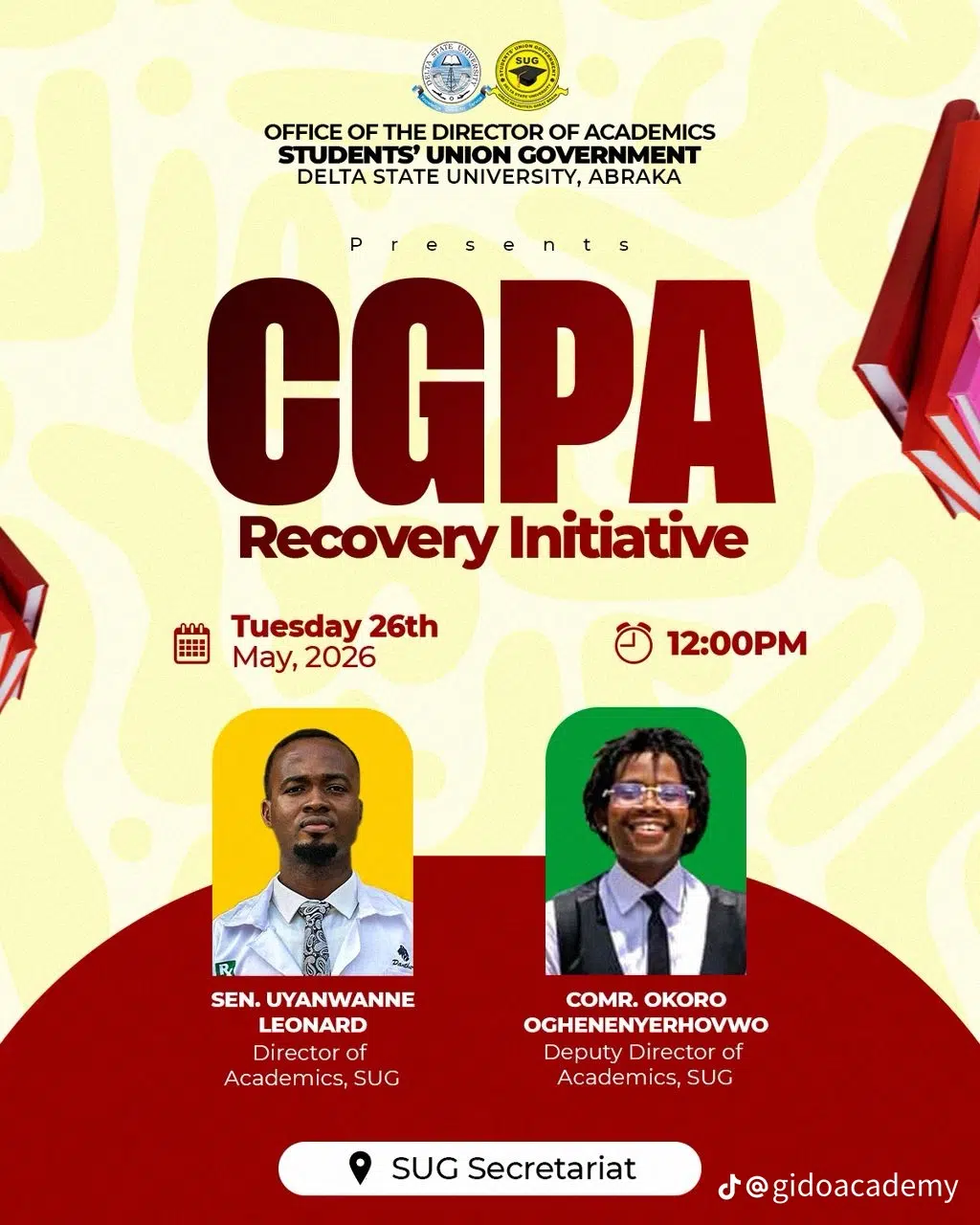
DELSU SUG Tackles Academic Decline with ‘CGPA Recovery Initiative’ for Junior Students
-
 Abraka Metro3 months ago
Rising House Rents Put Pressure on DELSU Students in Abraka
-

 Abraka Metro2 months ago
Elozino Ogege: Lecturers React As Court Sentences Killers Of DELSU First-Class Student To Death
-
 Education3 months ago
Challenges Persist at DELSU Agricultural Farm Despite Student Training
-

 Trending News3 months ago
Abraka Residents Advocate Entrepreneurship, Warn Against Gambling Amid Economic Hardship


