Trending News
Court Convicts Man For Attempted Murder, Rape, Abduction, Sentences Him To Life Imprisonment


By Tejiri Peter
The High Court of Justice of Delta State, sitting in the Abraka Judicial Division, has convicted Abraham Jepondy on charges of attempted murder, rape, and abduction, sentencing him to life imprisonment after finding that the prosecution proved its case beyond reasonable doubt.
Delivering judgment on Thursday, April 30, 2026, Hon. Justice Samuel I. Okeleke h eld that the prosecution successfully established the three offences through the direct evidence of the victim, corroborative medical evidence, circumstantial evidence, and the defendant’s extra-judicial statements.
Abraham Jepondy was arraigned before the court on a three-count charge filed on June 22, 2021, alleging that between January 1 and January 5, 2021, in Abraka, he attempted to murder Blessing Ineh by cutting her neck with a razor blade and a knife and stabbing her multiple times. He was also charged with rape for allegedly having unlawful sexual intercourse with the victim without her consent and with abduction for unlawfully taking and detaining her.
The charges were read and explained to the defendant on November 2, 2023, and he pleaded not guilty to all three counts, leading to a full trial.
The prosecution, led by Assistant Director in the Delta State Ministry of Justice, Mrs. A.N. Ukubeyinje-Mallarah, called five witnesses in support of its case. During the proceedings, the prosecution tendered 13 exhibits, including extra-judicial statements by witnesses and the defendant, blood-stained clothing recovered during the investigation, medical reports, photographs of the victim, a Certificate of Identification under Section 84 of the Evidence Act, and other police documents.
The defendant testified in his own defence and called one additional witness. No exhibit was tendered by the defence.
In reviewing the evidence, Justice Okeleke stated that the burden rested entirely on the prosecution to establish every element of the offences beyond reasonable doubt, in line with Section 135(1) of the Evidence Act, adding that the burden never shifted to the defendant.
The court held that proof beyond reasonable doubt may be established through direct eyewitness evidence, a voluntary confessional statement, or compelling circumstantial evidence.
The court first examined the testimony of PW1, Rachael Ineh, the victim’s mother, who said that on January 1, 2021, she sent her daughter to buy mosquito coils, but the child never returned home. After an unsuccessful search, she reported the matter to the police as a missing person case.
According to her testimony, on January 5, 2021, she received information from a boy identified as Miracle that someone was crying for help from inside a soak-away pit. She rushed to the scene, where her daughter was rescued with a deep cut on her neck, a stab wound on her back, white native chalk on her body, and a foul smell.
PW1 further testified that while the victim was being taken to Catholic Hospital, Abbi, the child identified Abraham Jepondy as the person responsible for abducting and attacking her.
The court also considered the testimony of PW2, Blessing Ineh, who was 13 years old when she testified. After satisfying itself that she possessed sufficient intelligence to testify, the court heard her account of the incident.
The victim testified that while running an errand to buy mosquito coils on January 1, 2021, the defendant asked her to help him buy sachet water and promised to give her ₦500 if she first handed over the ₦200 she was carrying. She said she followed him into a room, where he attacked her, inflicted injuries on her neck and back with sharp objects, gagged her, tied her hands and legs, and prevented her from escaping.
She further told the court that the defendant repeatedly raped her over five days against her will. According to her testimony, whenever she begged for water, he forced her to drink shampoo and chemicals used to treat wood against termites. She also testified that he rubbed white native chalk on her body and told her he intended to use her blood for ritual purposes.
The victim further narrated that after several days in captivity, the defendant blindfolded her, carried her to a soak-away pit, dumped her inside, threw a concrete block at her, covered the pit, and left her there until she was rescued.
Under cross-examination, the victim maintained that she knew the defendant before the incident as a carpenter living in a neighbouring compound and insisted that he alone abducted, raped, and assaulted her.
Addressing inconsistencies in her earlier statements referring to “three people,” she explained that she made those statements while drifting in and out of consciousness because of blood loss and trauma. After regaining full consciousness, she became certain that the defendant acted alone.
The prosecution also called ASP Precious Onyeoghani of the State Criminal Investigation Department (SCID), Asaba, who testified on the investigation after the case file was transferred from the Abraka Police Division.
He identified exhibits recovered during the investigation, including blood-stained clothing, a white cloth allegedly used to gag the victim, the defendant’s extra-judicial statements, police attestation forms, and medical records.
During cross-examination, the witness acknowledged that no DNA analysis, semen analysis, or blood typing was conducted but maintained that the exhibits formed part of the investigation.
The fourth prosecution witness, W/DSP Akporhanor Erebi, the initial Investigating Police Officer, testified that she received the missing person report on January 2, 2021.
She stated that after the victim was rescued on January 5, she visited the hospital, where the victim identified the defendant as her attacker and narrated how she had been lured, raped, assaulted, and dumped inside a soak-away pit.
The officer testified that she recovered blood-stained clothing from the scene, arrested the defendant after he had been apprehended by local youths, obtained his statement after administering the cautionary words, and later conducted an identification parade during which the victim identified him.
Under cross-examination, she admitted attempting to investigate the defendant’s alibi by contacting the phone number he provided and visiting the construction site where he claimed to have worked but acknowledged that those investigative steps were not recorded in her official diary.
The prosecution’s final witness, Dr. Stephenson Onyema, who testified virtually, informed the court that he examined the victim at Catholic Hospital, Abbi, on January 5, 2021.
According to him, the victim was pale, severely dehydrated, weak, and had multiple injuries, including a deep septic cut on her neck and bruises across her body.
The doctor further testified that examination of the victim’s genitalia revealed that her hymen was no longer intact and that bruises extended from the genital area toward the anus, findings he said were consistent with forceful penetration.
Although he acknowledged that no DNA or semen analysis was conducted, he maintained that the injuries were deliberate and consistent with sexual assault and attempted murder.
In his defence, Abraham Jepondy denied all the allegations and relied on an alibi.
He told the court that on January 1, 2021, he travelled to Ughelli to visit his cousin, Ossai Ese, returned to Abraka the following day, and then worked at a construction site for three days. He also alleged that his extra-judicial statements were obtained through torture, intimidation, and coercion by police officers.
During cross-examination, however, the prosecution pointed out inconsistencies between his testimony and that of his cousin regarding the visit to Ughelli. The defendant was also unable to provide the surnames of people he claimed to have worked with and could not satisfactorily explain why workers at the construction site allegedly failed to recognize him when police visited.
His cousin testified in support of the alibi but admitted under cross-examination that he was the defendant’s first cousin, wanted him released, and had no independent witness to corroborate his testimony.
After reviewing the evidence, Justice Okeleke held that the victim gave clear, direct, and consistent evidence identifying the defendant as the person who repeatedly raped her during five days of captivity.
The court ruled that the medical evidence corroborated her testimony and rejected the defence argument that the absence of DNA or semen analysis was fatal to the prosecution’s case, holding that credible direct evidence could sustain a conviction.
The judge also rejected the defendant’s challenge to the voluntariness of his extra-judicial statements, noting that they were admitted without objection and that a later retraction did not make them inadmissible.
On the plea of alibi, the court held that the victim’s positive identification of the defendant completely destroyed the defence and described the supporting testimony of the defence witness as unconvincing.
On the attempted murder charge, Justice Okeleke held that cutting the victim’s neck, stabbing her repeatedly, denying her food and water, forcing harmful substances down her throat, and dumping her alive in a soak-away pit clearly demonstrated an intention to kill.
The judge further held that the defendant’s alleged statement that he intended to use the victim’s head for ritual purposes showed premeditation and strengthened the prosecution’s case.
On the charge of abduction, the court found that the prosecution proved the defendant unlawfully lured the victim into his room, restrained her against her will for about five days, and detained her for sexual assault and bodily harm.
The court held that the contradictions identified by the defence were minor and did not affect the substance of the prosecution’s case.
Consequently, Abraham Jepondy was found guilty of attempted murder contrary to Section 320 of the Criminal Code Law of Delta State, rape contrary to Sections 357 and 358 of the Criminal Code Law of Delta State, and abduction contrary to Section 361 of the Criminal Code Law of Delta State.
Following the conviction, the defendant pleaded for mercy, telling the court, “My Lord, your judgment is right. I am guilty. I am pleading for mercy.”
Defence counsel, A.E. Osheri Esq., urged the court to temper justice with mercy, noting that the defendant had spent four years in detention, was a first-time offender, was still young, and had family members traumatized by his incarceration.
In sentencing, Justice Okeleke held that although the court considered the plea for mercy, the seriousness of the offences, the age of the victim, the brutality of the attack, the ritualistic threats, and the attempt to conceal the crime outweighed the mitigating factors.
Describing the defendant as a predator and a grave danger to vulnerable members of society, the judge said the offences warranted the maximum punishment permitted by law to reflect their gravity and serve as a deterrent.
The court sentenced Abraham Jepondy to life imprisonment for attempted murder, life imprisonment for rape, and seven years’ imprisonment for abduction, ordering that all the sentences run concurrently.
The prosecution was represented by Mrs. A.N. Ukubeyinje-Mallarah of the Delta State Ministry of Justice, while A.E. Osheri Esq. appeared for the defendant.









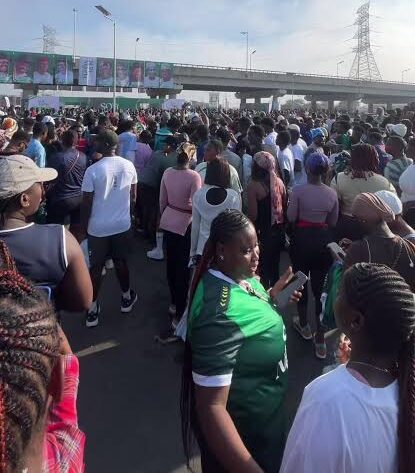
A Run and Rave event sponsored by Soft Nigeria in Warri, Delta State, was interrupted on Thursday after some participants protested against polo shirts bearing the image of President Bola Ahmed Tinubu.
The event, held at PTI Junction as part of activities marking Nigeria’s Independence Day, attracted young people who gathered for the fitness and entertainment programme.
According to videos and reports from the scene, some participants objected after shirts bearing Tinubu’s image were distributed. Some were seen tearing the shirts, while others chanted the name of Peter Obi and shouted, “We no go wear.”
Edema Seun, a young man who attended the Run and Rave event, said he encountered supporters of Peter Obi on his way to the venue but decided to remain at the event.
“I met the Obi supporters on the way and I stayed back to enjoy the event I came for. Later on I heard that there were burning shirts,” Seun said.
Seun’s account indicates that he did not personally witness the reported burning of the shirts, but learnt about it later during the event.
Videos circulating online showed some participants tearing the shirts, while others gathered around the area where the disagreement occurred. The available footage does not establish the political affiliation of all the participants or indicate that everyone at the event took part in the protest.
The incident has since attracted attention on social media, with reactions focusing on the use of a political figure’s image at an event presented as a fitness and entertainment programme.
The development comes amid increased political activity ahead of Nigeria’s 2027 general election, with supporters of different political figures increasingly visible at public gatherings and community events.
As of the time of filing this report, no detailed statement from Soft Nigeria explaining the distribution of the Tinubu-branded shirts or responding to the incident had been identified.
The Run and Rave event itself was organised as a fitness and entertainment gathering, while the political disagreement emerged during the programme over the shirts distributed to participants.
Politics
Nigeria @ 66: Tinubu Declares End of Emergency Reforms, Says Country Has Entered Age of Shared Prosperity

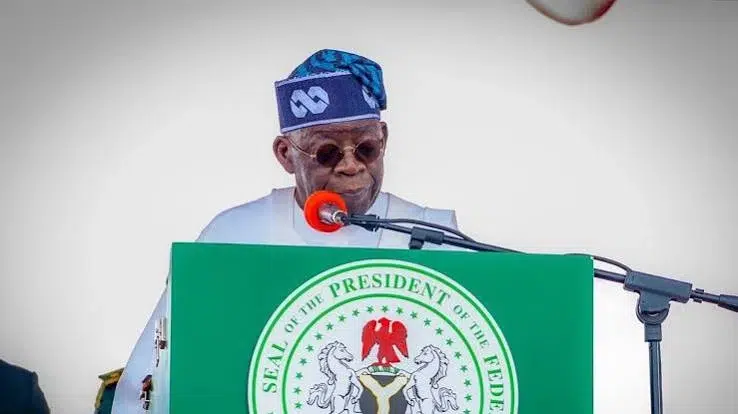
President Bola Ahmed Tinubu, Thursday, declared that Nigeria has passed the worst of its economic pains and has now entered the age of prosperity, in his 66th Independence Day address to the nation.
In an Independence Day celebration broadcast titled “From Reform to Prosperity”, the President said his administration chose to confront Nigeria’s deep economic distortions head-on when it assumed office in 2023, likening the country at that time to a cancer patient who must endure painful treatment to survive.
He said for too long Nigeria’s leaders chose morphine while praying for a miracle that never came, but his administration resolved to do things differently and excise the cancer.
Three and a half years after the removal of fuel subsidy and the foreign exchange reforms, Tinubu said the evidence of recovery is now undeniable.
He noted that the economy has grown by over four percent this year, with both oil and non-oil sectors contributing to stable growth, while oil theft has reduced and foreign direct investment continues to rise.
READ ALSO: Oborevwori, DELSU VC Hail Peretomode at Valedictory Lecture
According to him, inflation has fallen substantially from its peak, foreign reserves have been rebuilt and the foreign exchange market has stabilised.
He added that in 2025 the country recorded its highest revenue from non-oil exports in history, exceeding six billion dollars, which he described as real money being made by real Nigerian businesses.
These, he said, are not idle claims, as international observers, journalists, NGOs and multilateral institutions have all concluded that the reforms have strengthened Nigeria’s stability and resilience.
The President said that with the foundation now repaired, the central task of government has changed from correcting the economy to delivering shared and widespread prosperity.
He explained that prosperity to him does not mean merely larger numbers or better statistics, but a Nigeria where the farmer can cultivate safely and earn a decent return, where factories have reliable power, businesses can obtain credit, young people can find productive work, food and transportation are affordable, education is within reach, and families can look to the future with confidence.
To achieve this, Tinubu said his government will focus on bringing down the cost of living by lowering the cost of producing and moving goods.
He outlined plans to expand mechanised irrigation and dry-season farming, improve access to seeds and fertiliser, increase mechanisation, invest in storage and transportation, and build and complete roads, railways and ports that connect farms and factories to markets.
READ ALSO: Lawyers Advocate Speedy Justice For Litigants In Abraka Courts
His logic, he said, is simple: when farmers produce more cheaply, when fewer crops are lost between farm and market, when manufacturers spend less on electricity and trucks reach destinations faster in a competitive environment, those savings will ultimately reflect in market prices.
On jobs, the President said Nigeria’s youthful population must become an engine of production rather than a source of despair.
He pledged to use the nation’s gas to power new industries, support businesses to revive factories in industrial centres, expand digital connectivity into long-neglected communities, invest in relevant skills and provide infrastructure and finance for businesses to grow.
He said he wants to see more Nigerians making things, more farms feeding cities and supplying factories, more businesses selling Nigerian goods to the world, and young Nigerians building unicorns and creating opportunities at home.
Acknowledging that millions of citizens still struggle for daily meals, school fees and medical bills, the President said their plight is the accumulated consequence of decades of low productivity and weak institutions.
While this cannot be erased in four years, he said the course can be changed and the vulnerable will not be abandoned.
He pointed to strengthened direct support through an improved National Social Register for the poorest households, the Nigerian Education Loan Fund ensuring that children of low-income families can pursue higher education, and CREDICORP giving working Nigerians access to consumer credit for vehicles, solar systems and digital devices without years of savings.
He added that government has continued to pay salaries and pensions on time and in full, reformed the national pension programme, and is working with states and local governments to strengthen primary healthcare and basic education.
These programmes, he said, are not substitutes for prosperity but a bridge towards it, stressing that the objective is not to manage poverty more efficiently but to defeat it.
Tinubu urged Nigerians to resist calls by what he described as influential but regressive voices to abandon reforms and return to addictive subsidies, insisting that the nation must remember why the journey began.
He declared that the emergency treatment is over and the foundation has been repaired, saying Nigeria has corrected its course and passed through its own Red Sea.
While calling for unity and renewed faith, he said the promised land before the nation is one of abundance and opportunity where prosperity is broadly shared and every child can dream beyond the circumstances of birth.
He concluded that the destination is in sight, the foundations are strong and the direction is clear, urging Nigerians to go forward together with no looking back.
Education
DELSU Sets 77.3 as Highest Cut-Off Mark for 2026/2027, As Clinical Medicine Leads Admission Race

Delta State University, Abraka has released its approved UTME cut-off marks for the 2026/2027 admission session.
The release comes barely 24 hours after the state-owned institution released its first batch of admission for the incoming session.
The announcement, released on Wednesday, 9th September 2026 by the Public Relations Unit of the Directorate of Ceremonials, Information and Public Relations, spells out the minimum scores candidates must attain across the university’s 16 faculties to qualify for admission.
Leading the pack is the Faculty of Clinical Medicine, where Clinical Science carries the highest cut-off of 77.3.
This is closely followed by other health and professional courses that remain the most competitive in the university.
Nursing Science requires 71.2, while Law is set at 70.5. Both Dentistry and Pharmacy also stand at 70.0.
The story is different in several other faculties where the baseline cut-off remains at 40.
This applies to most programmes in the Faculties of Agriculture, Education, Environmental Sciences, and Social Sciences.
In the Faculty of Allied Health Sciences, candidates seeking admission into Medical Laboratory Science will need 65.3, while Pharmacology is pegged at 53.8 and Public Health at 50.
Candidates seeking admission into Engineering courses will have to meet varied benchmarks with Mechanical Engineering having the highest in the faculty at 52.5, followed by Petroleum Engineering at 51.5 and Electrical/Electronic Engineering at 50.5.
Chemical Engineering and Civil Engineering are lower at 45 and 42.9 respectively.
For management-related courses, Accounting leads with 56.7, Business Administration at 55.1, and Public Administration at 52.
In the Faculty of Communication and Media Studies, Mass Communication requires 55.7, while other programmes such as Advertising, Broadcasting, Journalism and Public Relations are at 40.
The Faculty of Computing also sets Computer Science at 56.5, with Cyber Security, Software Engineering, Information Technology and related courses pegged at 40.
In the Faculty of Arts, Theatre Arts and History & International Studies require 50 and 50.6 respectively, while English, French, Music,
Linguistics and Fine Arts are at 40. The Faculty of Science places Microbiology at 50 and Biochemistry at 48.2, with Physics, Chemistry, Mathematics, Geology and other courses at 40.
According to the university’s official bulletin dated Wednesday, 2nd September 2026, the new clearance process will be carried out entirely through the student’s portal.
-
 Education2 months ago
Breaking: DELSU Postpones Second Semester Examinations. See New Date
-
 Education3 months ago
DELSU Announces Admission Into New Diploma Programmes For 2026/2027 Academic Session
-
 Views Point3 months ago
OPINION: Agriculture, Nigeria’s Fading Goldmine
-

 Abraka Metro3 months ago
Experts Urge Students To Embrace AI With Open Hearts
-

 Education2 months ago
Breaking: DELSU Bans “Sign Out” Parties, Threatens 2-Semester Rustication For Violators
-
 Education3 months ago
28-Years-Old Man Swindles JUPEB Students, Diverts N15 Million School Fees
-
 Education2 months ago
DELSU Begins Postgraduate Admission for 2026/2027 Academic Session
-

 Entertainment3 months ago
World Cup 2026: US-Iran Tensions, Local Travel Hurdles, Global Friction Shape Fan Atmosphere
-

 Abraka Metro3 months ago
Rising Cost Of Living Forces Abraka Students To Adopt Survival Strategies
-
 Abraka Metro3 months ago
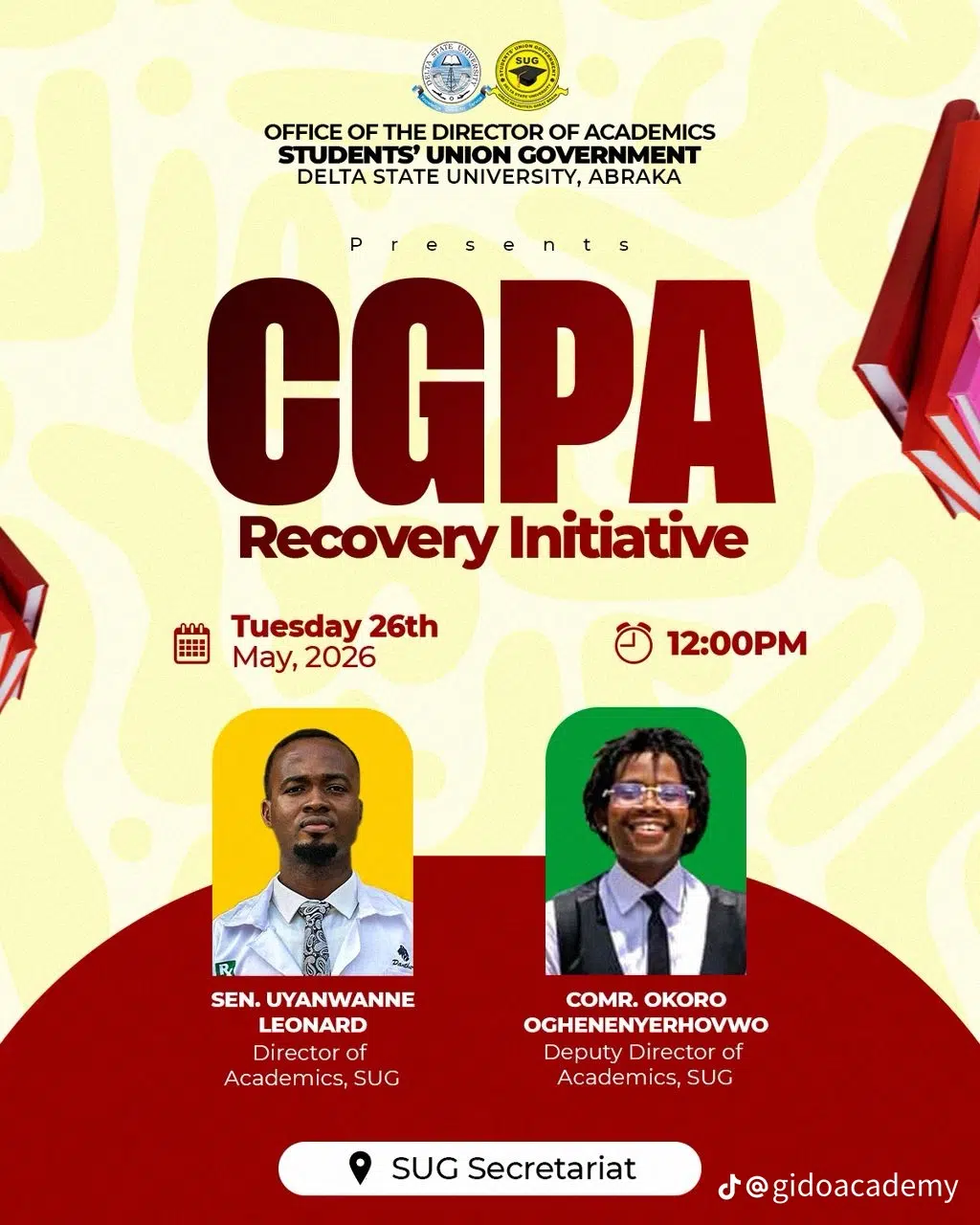
DELSU SUG Tackles Academic Decline with ‘CGPA Recovery Initiative’ for Junior Students
-
 Education2 months ago
DELSU Exam Monitors Apprehend Student With Allegedly Stolen Phones, Wig
-
 Abraka Metro3 months ago
Rising House Rents Put Pressure on DELSU Students in Abraka
-

 Abraka Metro2 months ago
Elozino Ogege: Lecturers React As Court Sentences Killers Of DELSU First-Class Student To Death
-
 Education3 months ago
Challenges Persist at DELSU Agricultural Farm Despite Student Training
-
 Trending News3 months ago
Abraka Residents Advocate Entrepreneurship, Warn Against Gambling Amid Economic Hardship


