Education
Plague: Theatre Arts Students Stage Drama On The Dangers Of Ill-Gotten Wealth


By Onovughe Oghenemine
Hundred level students from the Department of Theatre Arts performed a play titled PLAGUE, which depicts the causes of ill-gotten wealth, and how some parents act unconcerned.
The play, presented in six scenes, tells about a family where the father is a warrant officer in the army and the mother is a secondary school teacher.
They have two children. Voke a 15-year-old secondary school student in SS1, and Kome a 200-level university student.
The motherpressured her son (Voke) into joining a Yahoo group and made him shoulder most of the bills in the home without the father’s knowledge.
The sister, on the other hand, bought both her parents wristwatches.
The mother accepted hers, but the father did not.
Rather, he questioned how a student of her age could afford something as expensive as two million, five hundred thousand naira, but she gave no response.
Scene one ended with the boy being arrested.
His mother went to bail him, but the officers did not allow her.
Voke later sold all the cars and wristwatches and realized the sum oftwo hundred million naira, which he used to bail himself.
Later in the play, the mother fell sick, and Voke admitted that he had used her for money rituals, saying she would live to see herself rot until she died.
In another scene, Voke’s uncle, who was the mother’s brother, tried to make her realize that she should not be comfortable with the ill-gotten wealth her son was making and that this act was a plague affecting the world and the younger generation today.
Jadin, a hundred level student from the Department of English and Literary Studies (ELS), who watched the play, said another factor that causes young people to get involved in illgotten wealth is lack of contentment and pressure.
“If Kome’s mother had been content with what she and her husband were earning, even though it was small, she wouldn’t have pressured her son, Voke, into joining the Yahoo group,” he said.
Prince will, one of the actors who played the role of Voke’s uncle, said the play reminded him of an incident he witnessed where a lady lost her life because she was used for money rituals by her own child.
“My appeal to parents is that they should reject every act of greed for wealth, even when it involves evil.
“They should be content and encourage their children for every little achievement so that incidents like this can be curbed,” he said.
Yome, one of the students who handled the props, said most parents become victims unknowingly because they fail to question the source of their children’s wealth.
“One way of avoiding situations like this is for parents to always know their children and ask questions about their source of income,” she said.
Some of the challenges encountered while acting the play included getting costumes such as police uniforms and military wear for the father.
“Although we were able to get some costumes, such as those of the nurse and doctor, getting military and police uniforms for the major characters was difficult, so we had to improvise,” said Favour, one of the participants.
Another student, Blessing, said another challenge they faced was getting all their coursemates to attend rehearsals.
“At times, some students did not come for rehearsals, some came late, while others did not take their roles seriously.
“These were some of the challenges we encountered in making sure the play was presented successfully,” she said.
Some of the students who participated in the production expressed concern that despite the experience they gain through practical stage performances in school, securing opportunities after graduation remains a major challenge because of the country’s economic situation and the limited number of jobs available in the entertainment industry.
The stage presentation attracted students from different departments who applauded the cast for their performance and the moral lessons conveyed through the play.
Many audience members described the production as timely, noting that it addressed the growing concern over internet fraud, greed, and the pressure on young people to acquire wealth at all costs.
The performance also highlighted the importance of theatre as a tool for educating society and promoting positive values.
Through drama, the students demonstrated how entertainment can be used to address social issues and encourage positive behavioural change among young people.
The presentation served not only as a practical exercise for the Theatre Arts students, but also as a reminder that the pursuit of quick riches often comes with devastating consequences.





By Harrenta Brown
As Nigeria celebrates 66 years of independence today, 42 reportedly children taken from a school in Borno State have spent 139 days in captivity.
They were abducted on May 15th 2026 from Mussa Primary and Junior Secondary School in Borno State.
Six weeks later, on June 29, a second attack struck the same local government area.
Gunmen reportedly raided Government Day Secondary School in Lassa about 20 km from Mussa, killing a teacher who refused to go with them and abducting 36 students and one more teacher.
Gunmen struck two schools on May 15th in Oyo State and Borno State.
In Oyo, 39 children and seven teachers were abducted. l
The Oyo case became a viral topic and made news headlines within days, driven by outrage after one of the kidnapped teachers, Mr. Michael Oyedokun, was beheaded. Social media coverage was constant, and 56 days later, on July 10th, the surviving Oyo children and teachers were released.
Many Nigerians are shocked to learn for the first time that these children have been in captivity for that long.
Their shock is followed by a question: How did this happen without them knowing?
For most of the past four and a half months, most Nigerians had no idea they were still in captivity. Interviewed individuals’ reactions have ranged from disbelief to suspicion of a deliberate silence.
Kamsi and his friend Victor both believe the government’s silence is political, as they pointed to next year’s election, saying “the media isn’t talking about it because it reflects badly on the country and on the coming election”.
Judith had no idea the children were still missing.
“It’s evil and heartbreaking that these children are still in captivity while the government remains silent,” she said.
Enor reacted with the same shock, saying she had no idea and called for the government’s transparency, also urging officials to update citizens on the case so the children do not become forgotten the way the Chibok girls were.
Another Nigerian who asked not to be named wondered why a country was celebrating its independence when it truly had no independent security forces.
He asked who was to be blamed and believes that the silence has a regional dimension.
He argued that Northern Nigeria receives less attention than the South, and that the case would have moved faster if influencers and politicians got involved the same way they did with the Oyo case.
Tife, a corper, wondered why there were no press conferences and coverage on the matter, and why it wasn’t being treated with urgency.
She feared she could have been the one taken and forgotten.
The big questions Nigerians are asking now are not only where the children are, but why has the case not generated the same urgency as the Oyo State case?
They also questioned the celebration of independence as a country when children of the country are still in captivity.
Two kidnappings on the same day, but with two entirely different outcomes.
As of today, the two attacks combined have left 78 schoolchildren from the same corner of Borno State in captivity, 42 from Mussa, now at 139 days, and 36 from Lassa, now at 94 days.
Two kidnappings that happened 45 days apart in the same local government area and neither has produced a rescue.

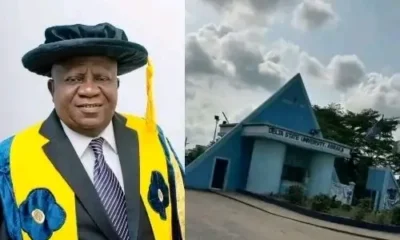
A former Vice-Chancellor of Delta State University, Abraka, Prof. Victor Peretomode, has proposed a tripartite governance model to sustain excellence in the institution.
Peretomode proposed the model at DELSU’s 12th valedictory lecture held on Thursday, September 24, 2026, at the university’s 750 Lecture Theatre, Site III.
The lecture was titled, “DELSU and the Burden of Expectation: The Challenges of Being Delta State’s Premier University and Rethinking Governance for Sustainable Excellence.”
He said as the state’s premier university, DELSU carries triple burdens — aspirational, political and operational — which translate into expectations such as expanding access to university education for Deltans, accommodating qualified indigenes, advancing state-specific development priorities and producing morally sound and employable graduates.
READ ALSO: DELSU Exam Monitors Apprehend Student With Allegedly Stolen Phones, Wig
Peretomode, a Professor of Educational Administration and Higher Education, said the challenges could be addressed through his proposed “Peretomode Tripartite Model of Governance for Sustainable Excellence,” anchored on three pillars: Leadership Integrity, Funding Predictability and Quality Assurance.
He observed that DELSU has come far, but its journey is far from complete, adding that the burden of expectation it carries is not a weight to be feared, but a responsibility to be fulfilled.
In his remarks, Governor Sheriff Oborevwori, Visitor to the university, described Peretomode as an academic who contributed immensely to the development of university education in the state.
Oborevwori, who was represented by the Commissioner for Higher Education, Prof. Nyerhovwo Tonukari, said the state would still need Peretomode’s wealth of experience as he bows out of service and assured of continued support for DELSU.
On his part, the Vice-Chancellor of DELSU, Prof. Samuel Asagba, lauded Peretomode’s achievements as former VC, noting that his policies, though considered harsh at the time, have placed the university in its present enviable state.
Asagba wished the valedictory lecturer the best in his future endeavours.
Highlights of the event included the launch of two books authored by the valedictory lecturer and a musical rendition by the Department of Music.
Peretomode joined DELSU in 1992 as Senior Lecturer in the Department of Educational Management and Foundations, became a Professor in 1996 and served as its 7th substantive Vice-Chancellor from 2014 to 2019.
The lecture was attended by the Vice-Chancellor of University of Delta, Agbor, Prof. Eric Eboh, Vice-Chancellor of Southern Delta University, Ozoro, Prof. Sunny Awhefeada, DELSU Deputy Vice-Chancellor (Administration), Prof. Edmund Atakpo, DELSU Deputy Vice Chancellor (Academic), Prof. Hilary Owamah, DELSU Deputy Vice-Chancellor (Research and Innovation), Prof. Douglasson Omotor, Deputy Vice-Chancellor, University of Delta, Agbor, Prof. Patrick Ijeh, Provost of Oleh Campus, Prof. Augustine Atonuje, DELSU Registrar, Mrs Rufina Ufiofio, DELSU Bursar, Mrs Otimeyin Ekakitie-Omajuwa, DELSU Librarian, Dr Josephine Onohwakpor, Provosts, Deans, Directors, staff and students of the university.
Also in attendance were the Rector of Delta State Polytechnic, Otefe-Oghara, Prof. Emmanuel Ufuophu-Biri, Rector, Delta State Marine Polytechnic, Burutu, Prof. Emmanuel Okoro, Delta business tycoon, Chief Tunde Smooth, Executive Director of Project, DESOPADEC, Chief (Dr) Ebenezer Okorodudu, former DELSU Governing Council Chairman, Prof. Sam Oyovbaire, former Dennis Osadebey University Governing Council Chairman, Prof. Robert Ikomi, members of DELSU College of Chaplains, friends and family members of the valedictory lecturer, including his wife, Dr (Mrs) Otaroghene Peretomode.
The release comes barely 24 hours after the state-owned institution released its first batch of admission for the incoming session.
Education
DELSU Sets 77.3 as Highest Cut-Off Mark for 2026/2027, As Clinical Medicine Leads Admission Race


Delta State University, Abraka has released its approved UTME cut-off marks for the 2026/2027 admission session.
The release comes barely 24 hours after the state-owned institution released its first batch of admission for the incoming session.
The announcement, released on Wednesday, 9th September 2026 by the Public Relations Unit of the Directorate of Ceremonials, Information and Public Relations, spells out the minimum scores candidates must attain across the university’s 16 faculties to qualify for admission.
Leading the pack is the Faculty of Clinical Medicine, where Clinical Science carries the highest cut-off of 77.3.
This is closely followed by other health and professional courses that remain the most competitive in the university.
Nursing Science requires 71.2, while Law is set at 70.5. Both Dentistry and Pharmacy also stand at 70.0.
The story is different in several other faculties where the baseline cut-off remains at 40.
This applies to most programmes in the Faculties of Agriculture, Education, Environmental Sciences, and Social Sciences.
In the Faculty of Allied Health Sciences, candidates seeking admission into Medical Laboratory Science will need 65.3, while Pharmacology is pegged at 53.8 and Public Health at 50.
Candidates seeking admission into Engineering courses will have to meet varied benchmarks with Mechanical Engineering having the highest in the faculty at 52.5, followed by Petroleum Engineering at 51.5 and Electrical/Electronic Engineering at 50.5.
Chemical Engineering and Civil Engineering are lower at 45 and 42.9 respectively.
For management-related courses, Accounting leads with 56.7, Business Administration at 55.1, and Public Administration at 52.
In the Faculty of Communication and Media Studies, Mass Communication requires 55.7, while other programmes such as Advertising, Broadcasting, Journalism and Public Relations are at 40.
The Faculty of Computing also sets Computer Science at 56.5, with Cyber Security, Software Engineering, Information Technology and related courses pegged at 40.
In the Faculty of Arts, Theatre Arts and History & International Studies require 50 and 50.6 respectively, while English, French, Music,
Linguistics and Fine Arts are at 40. The Faculty of Science places Microbiology at 50 and Biochemistry at 48.2, with Physics, Chemistry, Mathematics, Geology and other courses at 40.
According to the university’s official bulletin dated Wednesday, 2nd September 2026, the new clearance process will be carried out entirely through the student’s portal.
-
 Education2 months ago
Breaking: DELSU Postpones Second Semester Examinations. See New Date
-
 Education3 months ago
DELSU Announces Admission Into New Diploma Programmes For 2026/2027 Academic Session
-
 Views Point3 months ago
OPINION: Agriculture, Nigeria’s Fading Goldmine
-

 Abraka Metro3 months ago
Experts Urge Students To Embrace AI With Open Hearts
-

 Education2 months ago
Breaking: DELSU Bans “Sign Out” Parties, Threatens 2-Semester Rustication For Violators
-
 Education3 months ago
28-Years-Old Man Swindles JUPEB Students, Diverts N15 Million School Fees
-
 Education2 months ago
DELSU Begins Postgraduate Admission for 2026/2027 Academic Session
-

 Entertainment3 months ago
World Cup 2026: US-Iran Tensions, Local Travel Hurdles, Global Friction Shape Fan Atmosphere
-
 Abraka Metro3 months ago
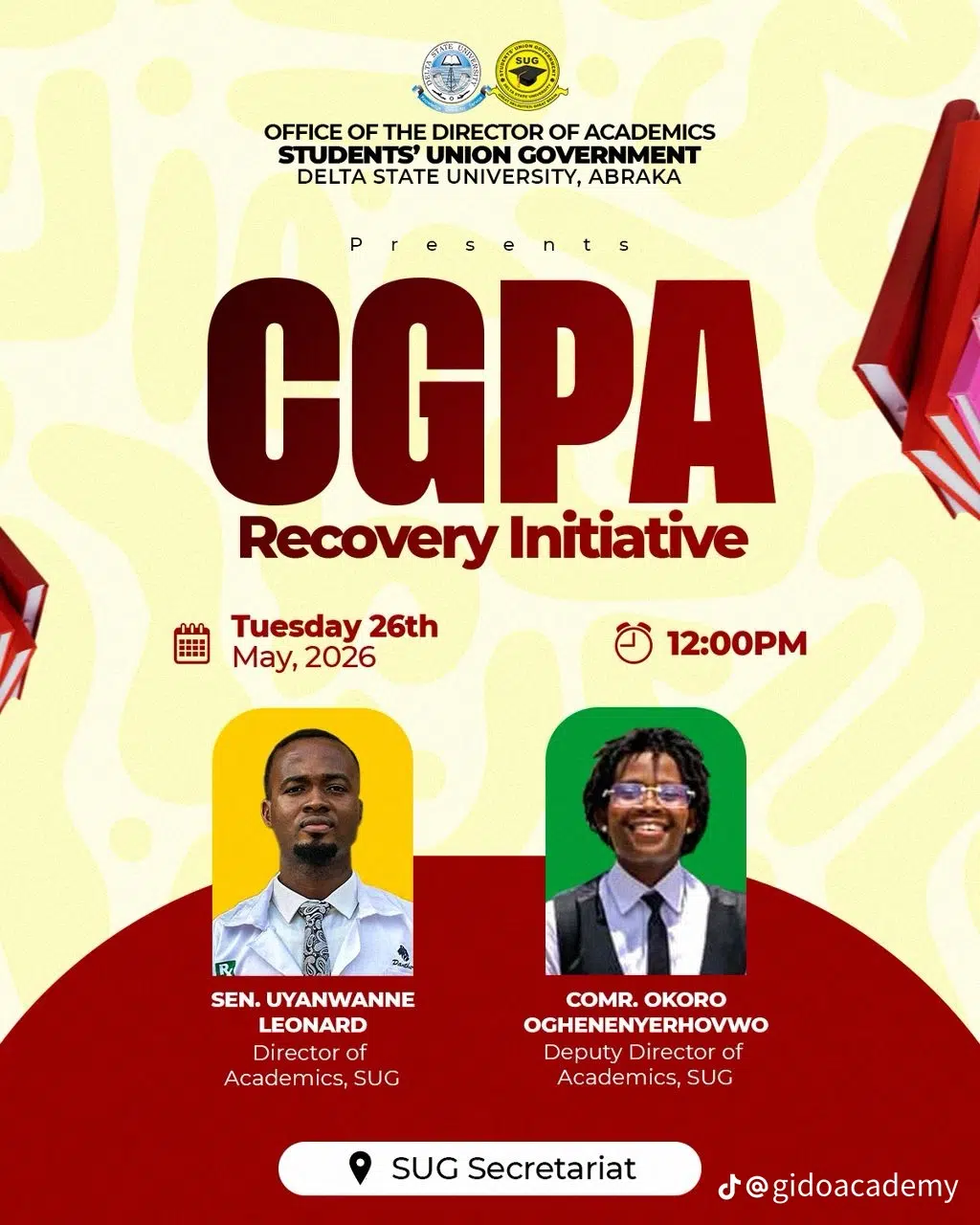
DELSU SUG Tackles Academic Decline with ‘CGPA Recovery Initiative’ for Junior Students
-

 Abraka Metro3 months ago
Rising Cost Of Living Forces Abraka Students To Adopt Survival Strategies
-
 Education2 months ago
DELSU Exam Monitors Apprehend Student With Allegedly Stolen Phones, Wig
-
 Abraka Metro3 months ago
Rising House Rents Put Pressure on DELSU Students in Abraka
-

 Abraka Metro2 months ago
Elozino Ogege: Lecturers React As Court Sentences Killers Of DELSU First-Class Student To Death
-

 Trending News3 months ago
Abraka Residents Advocate Entrepreneurship, Warn Against Gambling Amid Economic Hardship
-
 Education3 months ago
Challenges Persist at DELSU Agricultural Farm Despite Student Training


