
Entertainment
Raising Children in the Age of Social Media: The New Parenting Challenge in Nigeria


By Belle Ogigbah
There was a time when Nigerian parents worried primarily about the friends their children kept, the books they read, the television programmes they watched and the places they visited.
Today, a child can be physically present in the living room while psychologically living in a completely different world through a smartphone.
A few taps can connect a Nigerian child to millions of people around the world. That access offers enormous educational and creative possibilities. But it also presents parents with a challenge previous generations never had to confront on this scale: how do you protect a child from harmful influences when those influences can enter the home through a device held in the child’s hands?
Social media has become an important part of modern childhood. Platforms such as TikTok, YouTube, Instagram and other digital services expose young people to entertainment, information, trends, celebrities and communities.
For responsible users, these platforms can be valuable. Children can learn languages, science, technology, music, art and other skills. Young people can discover career opportunities and express their creativity.
The danger lies in the absence of adequate guidance. Children are still developing emotionally and intellectually. They may struggle to distinguish between reality and carefully manufactured online images.
Social media can create unrealistic expectations about beauty, wealth, relationships and success. A young person constantly exposed to images of expensive cars, designer clothes, luxurious holidays and seemingly perfect lifestyles may begin to believe that everyone else is succeeding except them.
The consequences can include frustration, low self-esteem and unhealthy comparison. There is also the issue of online bullying. Unlike traditional bullying, which may end when a child leaves school, cyberbullying can follow a child into the bedroom. Hurtful comments, embarrassing images and humiliating messages can circulate rapidly and remain online.
Parents also face the challenge of inappropriate content. The internet does not know that a particular user is twelve years old. Unless safeguards are put in place, children can encounter violent, sexual or otherwise unsuitable material.
Yet simply banning social media may not be enough. Young people are likely to find ways around restrictions, particularly when their friends are active online. The better approach is digital parenting. Parents need to know what platforms their children use, who they interact with, what content they consume and how much time they spend online.
More importantly, parents need to talk to their children. A child who fears punishment for every mistake may hide dangerous online experiences from parents. A child who trusts a parent is more likely to report cyberbullying, inappropriate messages, suspicious adults or other troubling encounters.
Schools also have a responsibility. Digital literacy should go beyond teaching students how to operate computers. Young people need to understand privacy, misinformation, online manipulation, cyberbullying, responsible communication and the long-term consequences of digital footprints.
Parents themselves also need digital literacy. It is increasingly difficult for adults who do not understand the digital environment to guide children who have grown up inside it. The challenge is therefore not to keep children away from technology but to teach them how to use it responsibly.
Children need boundaries. They need screen-time limits, age-appropriate content and supervision. But they also need conversation, trust and moral guidance.
The values parents hope to teach their children (honesty, respect, empathy, discipline, responsibility and compassion) must be extended into the digital environment. Social media is not inherently good or bad.
Its impact depends significantly on how it is used and the structures surrounding its use. Nigeria’s parents therefore face a new responsibility: raising children who can navigate a world in which the difference between the physical and digital environment is increasingly blurred.
The smartphone may be small, but the world it carries is enormous. The question is no longer whether Nigerian children will enter that world. They already have. The question is whether parents, schools and society will give them the wisdom to navigate it safely.








In Nigeria’s entertainment history, few female musicians have left a legacy as enduring as Christy Essien-Igbokwe.
Her success as a singer, actress and music administrator made her one of the pioneers who transformed the country’s music industry.
Born in Akwa Ibom State, Christy discovered her passion for music at an early age and steadily built a successful career that produced numerous hit songs and award-winning albums.
Her performances in different Nigerian languages enabled her to connect with audiences from diverse cultural backgrounds.
Apart from entertaining millions of fans, she used her influence to advocate for women and children through music and film.
Her emergence as the first female president of PMAN also demonstrated her leadership and commitment to the growth of Nigeria’s entertainment industry.
Today, years after her passing, Christy Essien-Igbokwe’s songs remain popular, while her achievements continue to inspire upcoming artists.
Her life stands as proof that talent, hard work and determination can create a legacy that outlives generations.
Entertainment
“They Were touching Me Everywhere”: Lady Alleges Gang Assault In Delta Community Festival, Begs For Police Action

By Annabella Esiri/David Akpovwa
A young lady has gone public with allegations that she was assaulted and nearly gang-raped by a group of men in Otor-Iyeded community in Isoko North Local Government Area of Delta State, during a local festival.
In a video shared on TikTok under the handle @dge_redoii, the lady, who appeared distressed and was speaking from what she said was a hospital, recounted that the incident occurred on the day she went out to get kegs for her business in Ugele.
According to her account, she entered a commercial motorcycle to Otor-Iyede, which she identified as her father’s village.
She alleged that upon arrival, a group of more than 20 men surrounded her.
“I was minding my business and then about four immediately dragged me out and dragging my hair, using stick to beat me,” she said in the video.
She further alleged that the men touched her inappropriately and attempted to take her to a hotel.
The woman said she was rescued after calling her mother, who then contacted relatives.
She stated that her uncles and the police were alerted and she was taken to her uncle’s house.
She expressed frustration over the response she received from community members, alleging that she was told “this is the tradition” and that “they are not going to do anything.”
“I don’t have evidence because I could not video it… but they should do something about it,” she said, appealing for authorities to investigate.
As of the time of filing this report, the Delta State Police Command has not released an official statement on the allegation.
Efforts to reach community leaders in Otor-Iyede for comment were ongoing.
Human rights advocates have urged the police to investigate the claims thoroughly and ensure the safety of the alleged victim.
The video has since sparked reactions online, with many calling for justice and protection for women and girls during cultural festivals.
Editor’s Note: The allegations in this report are based on the account given by the individual in a public video. Delta State University, Abraka, and other authorities have not yet confirmed the details. Victims of sexual assault are advised to seek medical attention and report to the nearest police station or support organizations.
If you or someone you know has experienced sexual violence, you can contact the Nigeria Police Force, NAPTIP, or local support centers for assistance.

By Osarumwense Success
Popular Nigerian TikTok streamer Habeeb Hamzat, popularly known as Peller, has married fellow content creator Amadou Elizabeth Aminata, known online as Jarvis.
The wedding trended across TikTok, X and Instagram for over a week and has sparked wide debate among young people.
Recall, Peller rose to fame in 2024 through live streams and skits.
Jarvis, also a creator, is known for tech and comedy content.
The couple confirmed they had completed both traditional and court weddings in a private ceremony with family and close friends.
At Delta State University, DELSU, Abraka, the news dominated student conversations in lecture halls, hostels and on social media.
While some students celebrated the union, others questioned the timing, citing age, education, and career pressure.
To capture campus opinion, Interview was conducted with four DELSU students.
Their views reflect how young people on campus are processing marriage.
Isaac Gloria, a 200-level student from department of Mass Communication believes education and career stability should come before marriage.
“Honestly, I was shocked when I saw the videos. Peller is just 20 years old.
“His career is just starting to blow up and he has so much ahead of him.
“Marriage is not just love and posting pictures.
“It comes with bills, pressure and responsibilities that can distract you.
“I feel like education should have come first.
“He should finish school, build a stronger structure for his brand, and then think about marriage.
“Fame does not last forever.
“Trends change every month on TikTok.
“What happens if content creation slows down in two years?
“What will he fall back on?
“That is why having a degree and a backup plan matters.
“At 20, there is still a lot to learn about life, money and people.
“I am not saying he cannot marry later, but right now it feels rushed.
“He needs time to grow personally before adding the pressure of marriage.
“I wish them well, but I think the timing is wrong,” she said.
Ovie Efe, a 100-level student from the department of Film and Multimedia believe adults have the right to decide for themselves.
“No one has the right to choose for another person.
“Peller and Jarvis are both adults. If they love each other and they have decided to marry, then we should respect that.
“People online are acting like they know everything about their relationship but on the contrary we do not.
“Maybe they prayed about it.
“Maybe they talked to their families and planned it well.
“We cannot tell. Social media will always talk, whether it is good or bad.
“That is just how it is.
“Marriage does not mean your career must end.
“Look at creators abroad who got married young and are still doing very well because they support each other.
“Jarvis is also a creator, so she understands the job.
“That can even make things easier for them. Instead of dragging them, we should allow them to live.
“If it works, fine. If there are challenges, they will learn and adjust.
“It is their life, not ours,” he said.
Another student, who spoke on condition of anonymity, shared diverse views on the marriage, saying, “I do not think it is totally wrong, and I do not think it is totally right.”
“It depends on the couple.
“Marriage at 20 is possible, but it is not easy at all.
“There will be pressure from fans, pressure from content creation deadlines, and pressure from family expectations.
“If Peller and Jarvis have mentors and if they plan their finances well, it can work.
“But if they entered it without thinking, the stress can break them.
“Young couples in the public eye need counseling and strong boundaries.
“They must create time for work, time for rest, and time for each other.
“If they do not balance it, one side will suffer.
“Content creation is already stressful with trends and hate comments.
“Adding marriage means they must communicate more.
“My prayer is that they succeed, but they must be very intentional.
“They should also protect their privacy because too much public opinion can destroy a young marriage,” the person said.
Godsgift Smart a final-year from the department of Science Laboratory Technology , says the marriage can bring stability.
“I think it is a good decision.
“This content creation space is stressful.
“You are always online, always chasing trends, and always dealing with criticism.
“Having someone you trust by your side can help you stay grounded.
“Jarvis is also a creator, so she understands the pressure.
“That means they can support each other instead of fighting the job.
“Love and partnership matter a lot in this industry because it can be lonely.
“Age is just a number if two people are ready to work together and build.
“Many people criticize without knowing their background, their faith, or their plans.
“We do not know what God has told them. Instead of dragging them, we should encourage them.
“If this works, it will show other young people that you can build love and career at the same time.
“I wish them strength and peace,” he said.
Peller’s marriage to Jarvis has sparked real conversation at DELSU about age, education, career and love in the age of social media.
Some students say it is too early. Others say it is their choice.
Others believe it can work with planning, and some see it as a positive step.
As they begin married life in the spotlight, the outcome will likely depend on how they balance fame, responsibility and partnership.
-

 Education2 months ago
Breaking: DELSU Postpones Second Semester Examinations. See New Date
-

 Education3 months ago
DELSU Announces Admission Into New Diploma Programmes For 2026/2027 Academic Session
-

 Views Point3 months ago
OPINION: Agriculture, Nigeria’s Fading Goldmine
-

 Abraka Metro3 months ago
Experts Urge Students To Embrace AI With Open Hearts
-

 Education2 months ago
Breaking: DELSU Bans “Sign Out” Parties, Threatens 2-Semester Rustication For Violators
-

 Education3 months ago
28-Years-Old Man Swindles JUPEB Students, Diverts N15 Million School Fees
-

 Education2 months ago
DELSU Begins Postgraduate Admission for 2026/2027 Academic Session
-

 Entertainment3 months ago
World Cup 2026: US-Iran Tensions, Local Travel Hurdles, Global Friction Shape Fan Atmosphere
-

 Abraka Metro3 months ago
Rising Cost Of Living Forces Abraka Students To Adopt Survival Strategies
-
 Abraka Metro3 months ago
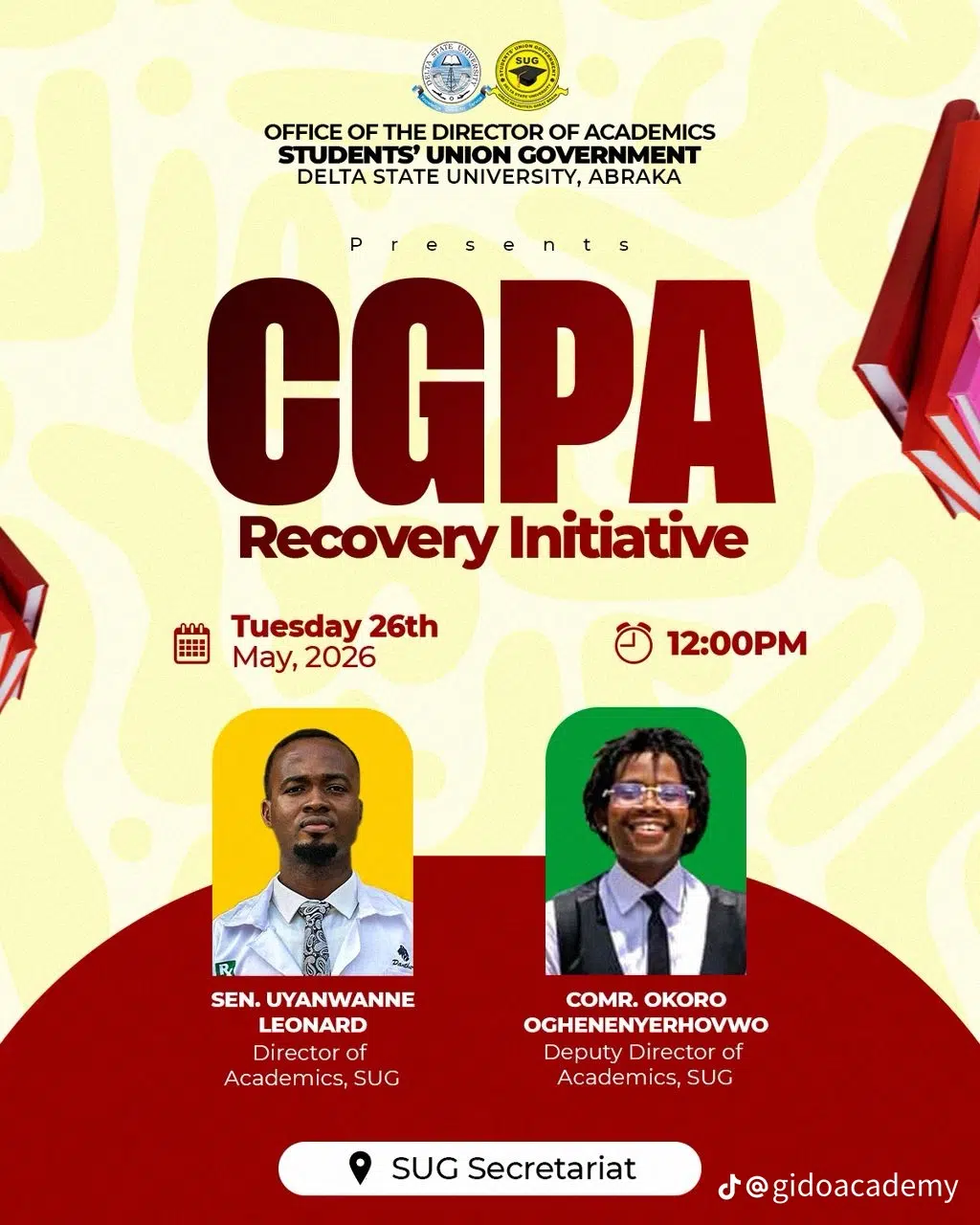
DELSU SUG Tackles Academic Decline with ‘CGPA Recovery Initiative’ for Junior Students
-

 Education2 months ago
DELSU Exam Monitors Apprehend Student With Allegedly Stolen Phones, Wig
-

 Abraka Metro3 months ago
Rising House Rents Put Pressure on DELSU Students in Abraka
-

 Abraka Metro2 months ago
Elozino Ogege: Lecturers React As Court Sentences Killers Of DELSU First-Class Student To Death
-

 Education3 months ago
Challenges Persist at DELSU Agricultural Farm Despite Student Training
-

 Trending News3 months ago
Abraka Residents Advocate Entrepreneurship, Warn Against Gambling Amid Economic Hardship


