Education
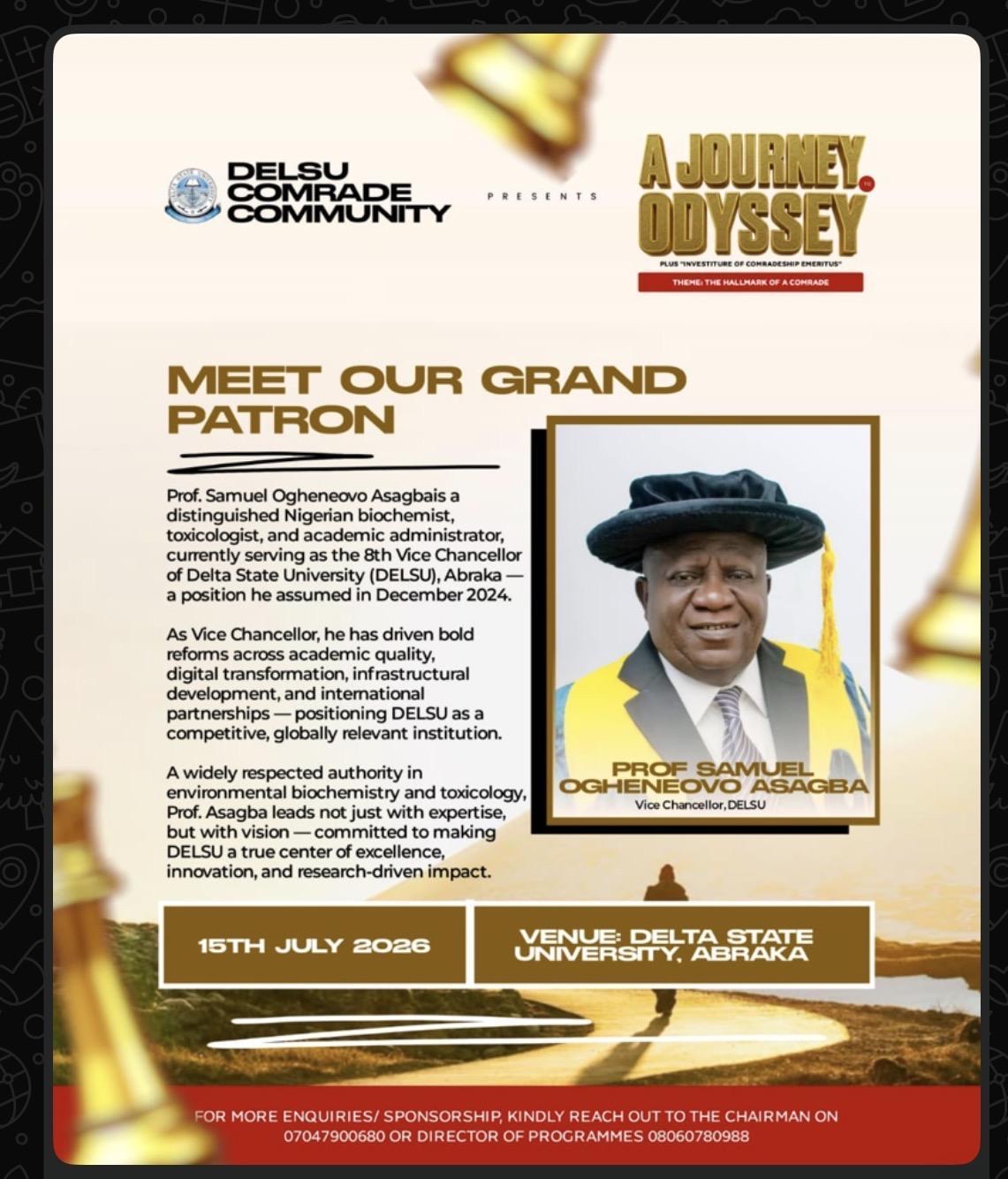
Comrade Community to Confer Grand Patron Award on DELSU VC July 15

By Confidence Igiebor
The Delta State University (DELSU) Comrade Community has announced plans to honour the Vice Chancellor, Prof. Samuel Asagba, with its prestigious Grand Patron Award in recognition of his outstanding leadership, commitment to students’ welfare and remarkable contributions to the growth and transformation of the institution.
The honour will be conferred during the community’s upcoming event titled “A Journey to Odyssey: The Hallmark of a Comrade,” a gathering expected to attract student leaders, comrades, academic staff, university administrators and members of the DELSU community to celebrate excellence in leadership, service, activism and institutional development.
According to the organisers, the decision to decorate Asagba as Grand Patron followed careful consideration of his achievements since assuming office as the eighth substantive Vice Chancellor of Delta State University, Abraka.
They described him as a visionary administrator whose leadership has introduced reforms that continue to reshape the university’s academic and administrative landscape.
READ ALSO: ASUU Raises Alarm Over Declining University Standards, Calls for Urgent Reforms
The organisers noted that the award is not merely ceremonial but serves as recognition of a leader whose policies have positively impacted both students and staff while positioning DELSU for greater national and international recognition.
“Professor Asagba has demonstrated exceptional commitment to the growth of Delta State University through innovative leadership, transparent administration and policies that place students at the centre of institutional development,” the organisers stated.
Media Conversation recalls that Asagba officially assumed office as Vice Chancellor on December 1, 2024 after a distinguished academic and administrative career spanning three decades within the institution.
A renowned professor of Biochemistry and respected authority in Environmental Biochemistry and Toxicology, Asagba joined the services of DELSU in 1994.
Throughout his years of service, he steadily rose through the ranks, occupying several strategic positions that prepared him for the university’s highest office.
Before becoming Vice Chancellor, he served as Head of Department, Dean of Faculty, Provost, and later Deputy Vice Chancellor, earning widespread respect for his administrative competence, academic excellence and dedication to institutional progress.
Since taking over the leadership of the university, Asagba has embarked on a series of reforms aimed at improving the quality of education, strengthening governance structures and enhancing DELSU’s reputation among higher institutions in Nigeria and beyond.
READ ALSO: DELSU-SUG Begins Week-Long Celebration, Targets Campus Inclusiveness
One of the most significant initiatives of his administration has been the digitalisation of academic and administrative processes, a policy that has modernised service delivery across the university.
The introduction of digital systems has simplified registration procedures, improved access to academic records, reduced bureaucratic delays and minimised unnecessary physical interactions between students and university officials.
Many students have described the reforms as timely, noting that they have made essential university services more accessible and efficient.
Beyond digital transformation, Asagba’s administration has continued to prioritise academic excellence by encouraging curriculum development, expanding academic programmes and promoting research across faculties.
His leadership has also focused on creating an environment where innovation and scholarly excellence can thrive.
Through increased support for research activities and academic collaborations, the university has continued to strengthen its position as one of Nigeria’s leading institutions of higher learning.
Infrastructure development has equally remained a key priority under his administration.
Several projects aimed at improving lecture halls, laboratories, office spaces and other learning facilities have either been completed or initiated to provide a more conducive environment for teaching, learning and research.
Staff welfare has also received significant attention.
The administration has continued to introduce policies designed to promote career development, improve working conditions and encourage professional growth among academic and non-academic staff.
These initiatives, university officials say, are intended to enhance productivity while maintaining high standards of service delivery.
Students have equally benefited from policies focused on creating a more stable and inclusive academic environment.
Through regular engagement with student representatives and stakeholders, the Vice Chancellor’s administration has sought to address challenges affecting students while promoting dialogue, peaceful coexistence and mutual understanding within the university community.
READ ALSO: Is A Good Name Better Than Riches? Reality Says Otherwise
The organisers of the award ceremony observed that these achievements reflect Asagba’s belief that sustainable institutional development can only be achieved through collaboration, innovation and inclusive governance.
Beyond the boundaries of DELSU, Asagba has continued to strengthen the institution’s international profile through partnerships with universities and research organisations across Africa, Europe, North America and Asia.
These collaborations have created opportunities for academic exchange, joint research, staff development and international networking, all aimed at enhancing DELSU’s global competitiveness.
His contributions to scientific research have equally earned him recognition within academic circles.
Widely respected for his work in environmental biochemistry and toxicology, Asagba has authored numerous scholarly publications and supervised research that has contributed to scientific knowledge both within Nigeria and internationally.
The DELSU Comrade Community described him as a leader whose achievements extend beyond administration, noting that his academic accomplishments and commitment to educational advancement make him a worthy recipient of the Grand Patron Award.
According to the organisers, “A Journey to Odyssey: The Hallmark of a Comrade” is more than a celebration of activism.
The event is designed to recognise individuals whose leadership, integrity and dedication have contributed significantly to the progress of the university and inspired positive change within the academic community.
The event is expected to bring together student union executives, faculty representatives, alumni, members of the university management, academic staff, non-academic staff and invited guests from different parts of the country.
Activities lined up for the occasion include keynote presentations, leadership discussions, cultural performances and the official decoration of Professor Asagba as Grand Patron of the DELSU Comrade Community.
Student leaders have welcomed the decision to honour the Vice Chancellor, describing it as a fitting recognition of a leader who has consistently demonstrated openness, accessibility and commitment to institutional excellence.
Many believe the award reflects the appreciation of the university community for an administration that has continued to pursue reforms aimed at improving academic standards, enhancing students’ experiences and strengthening DELSU’s reputation as a centre of excellence.
As preparations for the event gather momentum, anticipation continues to build across the university community.
For the DELSU Comrade Community, the Grand Patron Award represents more than an honour—it symbolises recognition of visionary leadership, academic excellence, institutional transformation and unwavering dedication to the advancement of DELSU.
Through this recognition, the community hopes to celebrate a Vice Chancellor whose tenure continues to shape the university’s future and reinforce its commitment to excellence, innovation and service.
The delegation, led by the Chapter President, Comr. Daniel Agadagba, visited the Dean’s office at Campus 2, Abraka, on Friday, July 3rd 2026.






By Harrenta Brown
As Nigeria celebrates 66 years of independence today, 42 reportedly children taken from a school in Borno State have spent 139 days in captivity.
They were abducted on May 15th 2026 from Mussa Primary and Junior Secondary School in Borno State.
Six weeks later, on June 29, a second attack struck the same local government area.
Gunmen reportedly raided Government Day Secondary School in Lassa about 20 km from Mussa, killing a teacher who refused to go with them and abducting 36 students and one more teacher.
Gunmen struck two schools on May 15th in Oyo State and Borno State.
In Oyo, 39 children and seven teachers were abducted. l
The Oyo case became a viral topic and made news headlines within days, driven by outrage after one of the kidnapped teachers, Mr. Michael Oyedokun, was beheaded. Social media coverage was constant, and 56 days later, on July 10th, the surviving Oyo children and teachers were released.
Many Nigerians are shocked to learn for the first time that these children have been in captivity for that long.
Their shock is followed by a question: How did this happen without them knowing?
For most of the past four and a half months, most Nigerians had no idea they were still in captivity. Interviewed individuals’ reactions have ranged from disbelief to suspicion of a deliberate silence.
Kamsi and his friend Victor both believe the government’s silence is political, as they pointed to next year’s election, saying “the media isn’t talking about it because it reflects badly on the country and on the coming election”.
Judith had no idea the children were still missing.
“It’s evil and heartbreaking that these children are still in captivity while the government remains silent,” she said.
Enor reacted with the same shock, saying she had no idea and called for the government’s transparency, also urging officials to update citizens on the case so the children do not become forgotten the way the Chibok girls were.
Another Nigerian who asked not to be named wondered why a country was celebrating its independence when it truly had no independent security forces.
He asked who was to be blamed and believes that the silence has a regional dimension.
He argued that Northern Nigeria receives less attention than the South, and that the case would have moved faster if influencers and politicians got involved the same way they did with the Oyo case.
Tife, a corper, wondered why there were no press conferences and coverage on the matter, and why it wasn’t being treated with urgency.
She feared she could have been the one taken and forgotten.
The big questions Nigerians are asking now are not only where the children are, but why has the case not generated the same urgency as the Oyo State case?
They also questioned the celebration of independence as a country when children of the country are still in captivity.
Two kidnappings on the same day, but with two entirely different outcomes.
As of today, the two attacks combined have left 78 schoolchildren from the same corner of Borno State in captivity, 42 from Mussa, now at 139 days, and 36 from Lassa, now at 94 days.
Two kidnappings that happened 45 days apart in the same local government area and neither has produced a rescue.

A former Vice-Chancellor of Delta State University, Abraka, Prof. Victor Peretomode, has proposed a tripartite governance model to sustain excellence in the institution.
Peretomode proposed the model at DELSU’s 12th valedictory lecture held on Thursday, September 24, 2026, at the university’s 750 Lecture Theatre, Site III.
The lecture was titled, “DELSU and the Burden of Expectation: The Challenges of Being Delta State’s Premier University and Rethinking Governance for Sustainable Excellence.”
He said as the state’s premier university, DELSU carries triple burdens — aspirational, political and operational — which translate into expectations such as expanding access to university education for Deltans, accommodating qualified indigenes, advancing state-specific development priorities and producing morally sound and employable graduates.
READ ALSO: DELSU Exam Monitors Apprehend Student With Allegedly Stolen Phones, Wig
Peretomode, a Professor of Educational Administration and Higher Education, said the challenges could be addressed through his proposed “Peretomode Tripartite Model of Governance for Sustainable Excellence,” anchored on three pillars: Leadership Integrity, Funding Predictability and Quality Assurance.
He observed that DELSU has come far, but its journey is far from complete, adding that the burden of expectation it carries is not a weight to be feared, but a responsibility to be fulfilled.
In his remarks, Governor Sheriff Oborevwori, Visitor to the university, described Peretomode as an academic who contributed immensely to the development of university education in the state.
Oborevwori, who was represented by the Commissioner for Higher Education, Prof. Nyerhovwo Tonukari, said the state would still need Peretomode’s wealth of experience as he bows out of service and assured of continued support for DELSU.
On his part, the Vice-Chancellor of DELSU, Prof. Samuel Asagba, lauded Peretomode’s achievements as former VC, noting that his policies, though considered harsh at the time, have placed the university in its present enviable state.
Asagba wished the valedictory lecturer the best in his future endeavours.
Highlights of the event included the launch of two books authored by the valedictory lecturer and a musical rendition by the Department of Music.
Peretomode joined DELSU in 1992 as Senior Lecturer in the Department of Educational Management and Foundations, became a Professor in 1996 and served as its 7th substantive Vice-Chancellor from 2014 to 2019.
The lecture was attended by the Vice-Chancellor of University of Delta, Agbor, Prof. Eric Eboh, Vice-Chancellor of Southern Delta University, Ozoro, Prof. Sunny Awhefeada, DELSU Deputy Vice-Chancellor (Administration), Prof. Edmund Atakpo, DELSU Deputy Vice Chancellor (Academic), Prof. Hilary Owamah, DELSU Deputy Vice-Chancellor (Research and Innovation), Prof. Douglasson Omotor, Deputy Vice-Chancellor, University of Delta, Agbor, Prof. Patrick Ijeh, Provost of Oleh Campus, Prof. Augustine Atonuje, DELSU Registrar, Mrs Rufina Ufiofio, DELSU Bursar, Mrs Otimeyin Ekakitie-Omajuwa, DELSU Librarian, Dr Josephine Onohwakpor, Provosts, Deans, Directors, staff and students of the university.
Also in attendance were the Rector of Delta State Polytechnic, Otefe-Oghara, Prof. Emmanuel Ufuophu-Biri, Rector, Delta State Marine Polytechnic, Burutu, Prof. Emmanuel Okoro, Delta business tycoon, Chief Tunde Smooth, Executive Director of Project, DESOPADEC, Chief (Dr) Ebenezer Okorodudu, former DELSU Governing Council Chairman, Prof. Sam Oyovbaire, former Dennis Osadebey University Governing Council Chairman, Prof. Robert Ikomi, members of DELSU College of Chaplains, friends and family members of the valedictory lecturer, including his wife, Dr (Mrs) Otaroghene Peretomode.
The release comes barely 24 hours after the state-owned institution released its first batch of admission for the incoming session.
Education
DELSU Sets 77.3 as Highest Cut-Off Mark for 2026/2027, As Clinical Medicine Leads Admission Race

Delta State University, Abraka has released its approved UTME cut-off marks for the 2026/2027 admission session.
The release comes barely 24 hours after the state-owned institution released its first batch of admission for the incoming session.
The announcement, released on Wednesday, 9th September 2026 by the Public Relations Unit of the Directorate of Ceremonials, Information and Public Relations, spells out the minimum scores candidates must attain across the university’s 16 faculties to qualify for admission.
Leading the pack is the Faculty of Clinical Medicine, where Clinical Science carries the highest cut-off of 77.3.
This is closely followed by other health and professional courses that remain the most competitive in the university.
Nursing Science requires 71.2, while Law is set at 70.5. Both Dentistry and Pharmacy also stand at 70.0.
The story is different in several other faculties where the baseline cut-off remains at 40.
This applies to most programmes in the Faculties of Agriculture, Education, Environmental Sciences, and Social Sciences.
In the Faculty of Allied Health Sciences, candidates seeking admission into Medical Laboratory Science will need 65.3, while Pharmacology is pegged at 53.8 and Public Health at 50.
Candidates seeking admission into Engineering courses will have to meet varied benchmarks with Mechanical Engineering having the highest in the faculty at 52.5, followed by Petroleum Engineering at 51.5 and Electrical/Electronic Engineering at 50.5.
Chemical Engineering and Civil Engineering are lower at 45 and 42.9 respectively.
For management-related courses, Accounting leads with 56.7, Business Administration at 55.1, and Public Administration at 52.
In the Faculty of Communication and Media Studies, Mass Communication requires 55.7, while other programmes such as Advertising, Broadcasting, Journalism and Public Relations are at 40.
The Faculty of Computing also sets Computer Science at 56.5, with Cyber Security, Software Engineering, Information Technology and related courses pegged at 40.
In the Faculty of Arts, Theatre Arts and History & International Studies require 50 and 50.6 respectively, while English, French, Music,
Linguistics and Fine Arts are at 40. The Faculty of Science places Microbiology at 50 and Biochemistry at 48.2, with Physics, Chemistry, Mathematics, Geology and other courses at 40.
According to the university’s official bulletin dated Wednesday, 2nd September 2026, the new clearance process will be carried out entirely through the student’s portal.
-

 Education2 months ago
Breaking: DELSU Postpones Second Semester Examinations. See New Date
-
 Education3 months ago
DELSU Announces Admission Into New Diploma Programmes For 2026/2027 Academic Session
-
 Views Point3 months ago
OPINION: Agriculture, Nigeria’s Fading Goldmine
-

 Abraka Metro3 months ago
Experts Urge Students To Embrace AI With Open Hearts
-

 Education2 months ago
Breaking: DELSU Bans “Sign Out” Parties, Threatens 2-Semester Rustication For Violators
-

 Education3 months ago
28-Years-Old Man Swindles JUPEB Students, Diverts N15 Million School Fees
-
 Education2 months ago
DELSU Begins Postgraduate Admission for 2026/2027 Academic Session
-

 Entertainment3 months ago
World Cup 2026: US-Iran Tensions, Local Travel Hurdles, Global Friction Shape Fan Atmosphere
-
 Abraka Metro3 months ago
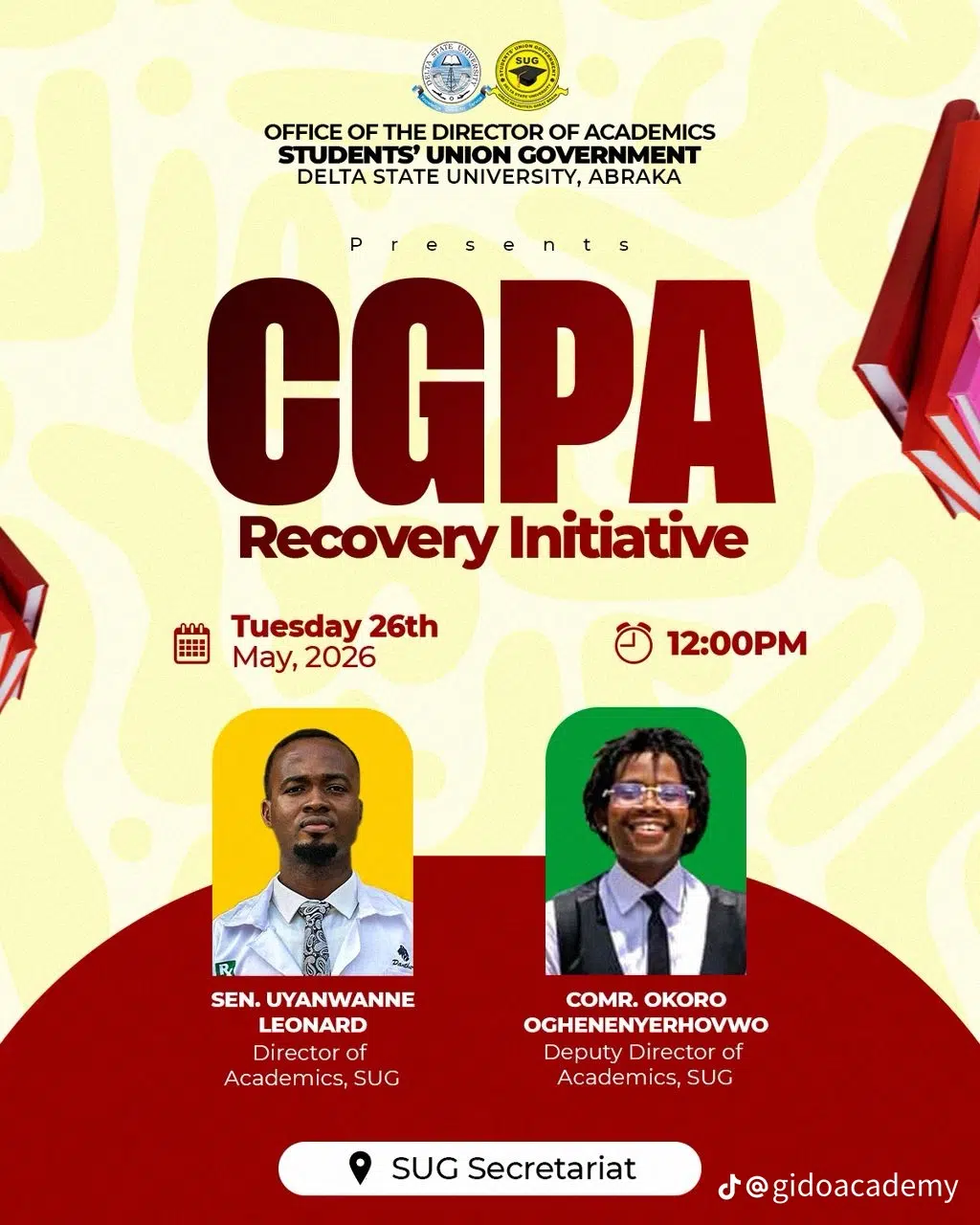
DELSU SUG Tackles Academic Decline with ‘CGPA Recovery Initiative’ for Junior Students
-

 Abraka Metro3 months ago
Rising Cost Of Living Forces Abraka Students To Adopt Survival Strategies
-

 Education2 months ago
DELSU Exam Monitors Apprehend Student With Allegedly Stolen Phones, Wig
-
 Abraka Metro3 months ago
Rising House Rents Put Pressure on DELSU Students in Abraka
-

 Abraka Metro2 months ago
Elozino Ogege: Lecturers React As Court Sentences Killers Of DELSU First-Class Student To Death
-
 Education3 months ago
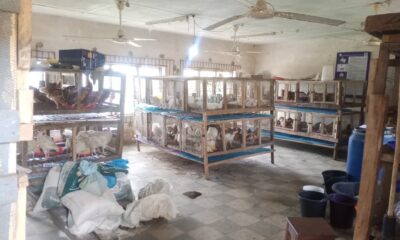
Challenges Persist at DELSU Agricultural Farm Despite Student Training
-

 Trending News3 months ago
Abraka Residents Advocate Entrepreneurship, Warn Against Gambling Amid Economic Hardship


