Show Biz
A Roof Over Their Heads: The Housing Struggles of DELSU Students

BY FRANCISCA UNUTAME
For many students of Delta State University (DELSU), Abraka, gaining admission into the institution is a dream come true. However, beyond the excitement of academic pursuits lies a major challenge that many students must confront: securing decent accommodation.
The search for housing in Abraka has become a frustrating experience for many students who are forced to navigate high rental costs, dishonest agents, poor living conditions, and the stress of balancing accommodation searches with academic responsibilities.
For Eneh Amarachi, a 100-level Sociology student, finding a place to live was anything but easy. What began as a hopeful search for a comfortable apartment quickly turned into weeks of disappointment and frustration. “It wasn’t easy at all,” she recalled. “I had to miss classes just to search for a house because what agents advertise is often different from what you eventually get.”
According to Amarachi, transportation expenses and consultation fees added to the burden. She explained that some agents charged consultation fees of up to ₦8,000, excluding transportation costs incurred while inspecting properties. Her experience reflects a common complaint among students in the university community. Many arrive with expectations shaped by attractive online videos and photographs, only to discover that the actual apartments fall far below what was advertised.
Eventually, Amarachi settled for an apartment that was not the exact one she had been shown. Although it was within the same compound, the room differed significantly from what she had expected.
“The apartment I got was not the one in the video. I was told the previous tenant had just moved out, and I had little choice but to accept it,” she said.
The challenges did not end there. Upon moving in, she discovered several issues that required immediate attention. She had to spend additional money repainting parts of the apartment, repairing damaged walls, fixing sections of the ceiling, and renovating the kitchen cabinet.
Despite these setbacks, Amarachi remains optimistic. She noted that living off campus allows her greater freedom to manage her side businesses as a makeup artist, hairstylist, and chef while pursuing her studies.
READ ALSO
DELSU SUG Tackles Academic Decline with ‘CGPA Recovery Initiative’ for Junior Students
Hope Rises for 160 Beneficiaries As Church Organises Free Medical Outreach in Abraka
Doubts, Criticisms Trail Tinubu’s Acclaimed 10 Million Votes Amid Nigeria’s Rising Voter Apathy
Nigeria’s Growing Insecurity Crisis: A Threat We Can No Longer Ignore
A similar story was shared by Eljim Elijah, a 200-level Fine and Applied Arts student, who described the housing search process as stressful and misleading. According to Elijah, one of the most frustrating aspects of searching for accommodation is dealing with agents who exaggerate the quality of available apartments. “Most agents post attractive videos online, but when you get there physically, the reality is completely different,” he said.
He lamented the widespread practice of charging consultation fees before students are allowed to inspect properties. In many cases, students pay these fees only to discover that the houses do not meet basic standards. “The consultation fees are often wasted because the houses we are shown are usually not worth the money,” Elijah explained.
Beyond the financial burden, Elijah highlighted other factors students must consider before renting a house, including water supply, electricity, security, waste disposal, and proximity to campus. These factors, he noted, significantly affect students’ comfort and academic performance.
For Mary, a 400-Level student of the Department of English Education, securing a place to stay in Abraka was one of the most difficult experiences she faced as a fresher. Coming all the way from Lagos, Mary arrived in Abraka with little knowledge of the town and no one to assist her in her search for accommodation.
Determined to settle down before academic activities began, she made the decision to resume earlier than most students. “I had to resume school before the official resumption date so that I could balance my house search with my studies,” she recalled.
According to her, several people advised her to arrive before other students resumed. They believed that getting accommodation would be easier before the influx of students into the town. Looking back, Mary admits that the advice proved valuable.
The search, however, was far from easy. Like many freshers unfamiliar with Abraka, she relied on agents to help her secure accommodation. Unfortunately, her first experience was disappointing. “The first agent kept taking me to houses that were far from the school and not really nice,” she explained.
Hoping for better results, Mary sought the services of another agent. However, the second agent’s efforts were not much different from the first. Despite the setbacks, she remained persistent and eventually found a house within two weeks of searching. While securing accommodation brought relief, another challenge soon emerged. The house that seemed suitable at first turned out to have a major problem lack of electricity. “I was told that the area had a steady power supply, but throughout the two years I lived there, there was no electricity,” she said. The situation made daily living difficult, affecting comfort and convenience. What was expected to be a conducive living environment became a source of frustration.
Today, Mary no longer lives in the house, but her experience highlights the realities many students face when searching for accommodation in university communities. Her story serves as a reminder that beyond the challenge of finding a house, students often have to contend with issues such as unreliable utilities, misleading information, and the stress of adapting to a new environment.
For fresher’s arriving in Abraka, Mary’s journey underscores the importance of early preparation, patience, and proper investigation before securing accommodation.Both students agreed that transportation remains another major challenge. Students who live far from campus often struggle to attend lectures regularly due to transportation costs and long commuting distances. Their experiences reveal a broader issue affecting many DELSU students. While off-campus accommodation offers freedom and privacy, the process of securing suitable housing is often marked by uncertainty, financial strain, and emotional stress.
As the student population continues to grow, many believe that greater regulation of house agents and improved access to affordable, student-friendly accommodation are necessary to ease the burden on students. Until then, many undergraduates in Abraka will continue to face the difficult task of finding a place they can truly call home while pursuing their academic goals.
The Author, Francisca Unutame is a 200 level journalism and media studies student of Delta State University Abraka.



In Nigeria’s entertainment history, few female musicians have left a legacy as enduring as Christy Essien-Igbokwe.
Her success as a singer, actress and music administrator made her one of the pioneers who transformed the country’s music industry.
Born in Akwa Ibom State, Christy discovered her passion for music at an early age and steadily built a successful career that produced numerous hit songs and award-winning albums.
Her performances in different Nigerian languages enabled her to connect with audiences from diverse cultural backgrounds.
Apart from entertaining millions of fans, she used her influence to advocate for women and children through music and film.
Her emergence as the first female president of PMAN also demonstrated her leadership and commitment to the growth of Nigeria’s entertainment industry.
Today, years after her passing, Christy Essien-Igbokwe’s songs remain popular, while her achievements continue to inspire upcoming artists.
Her life stands as proof that talent, hard work and determination can create a legacy that outlives generations.

By Osarumwense Success
Popular Nigerian TikTok streamer Habeeb Hamzat, popularly known as Peller, has married fellow content creator Amadou Elizabeth Aminata, known online as Jarvis.
The wedding trended across TikTok, X and Instagram for over a week and has sparked wide debate among young people.
Recall, Peller rose to fame in 2024 through live streams and skits.
Jarvis, also a creator, is known for tech and comedy content.
The couple confirmed they had completed both traditional and court weddings in a private ceremony with family and close friends.
At Delta State University, DELSU, Abraka, the news dominated student conversations in lecture halls, hostels and on social media.
While some students celebrated the union, others questioned the timing, citing age, education, and career pressure.
To capture campus opinion, Interview was conducted with four DELSU students.
Their views reflect how young people on campus are processing marriage.
Isaac Gloria, a 200-level student from department of Mass Communication believes education and career stability should come before marriage.
“Honestly, I was shocked when I saw the videos. Peller is just 20 years old.
“His career is just starting to blow up and he has so much ahead of him.
“Marriage is not just love and posting pictures.
“It comes with bills, pressure and responsibilities that can distract you.
“I feel like education should have come first.
“He should finish school, build a stronger structure for his brand, and then think about marriage.
“Fame does not last forever.
“Trends change every month on TikTok.
“What happens if content creation slows down in two years?
“What will he fall back on?
“That is why having a degree and a backup plan matters.
“At 20, there is still a lot to learn about life, money and people.
“I am not saying he cannot marry later, but right now it feels rushed.
“He needs time to grow personally before adding the pressure of marriage.
“I wish them well, but I think the timing is wrong,” she said.
Ovie Efe, a 100-level student from the department of Film and Multimedia believe adults have the right to decide for themselves.
“No one has the right to choose for another person.
“Peller and Jarvis are both adults. If they love each other and they have decided to marry, then we should respect that.
“People online are acting like they know everything about their relationship but on the contrary we do not.
“Maybe they prayed about it.
“Maybe they talked to their families and planned it well.
“We cannot tell. Social media will always talk, whether it is good or bad.
“That is just how it is.
“Marriage does not mean your career must end.
“Look at creators abroad who got married young and are still doing very well because they support each other.
“Jarvis is also a creator, so she understands the job.
“That can even make things easier for them. Instead of dragging them, we should allow them to live.
“If it works, fine. If there are challenges, they will learn and adjust.
“It is their life, not ours,” he said.
Another student, who spoke on condition of anonymity, shared diverse views on the marriage, saying, “I do not think it is totally wrong, and I do not think it is totally right.”
“It depends on the couple.
“Marriage at 20 is possible, but it is not easy at all.
“There will be pressure from fans, pressure from content creation deadlines, and pressure from family expectations.
“If Peller and Jarvis have mentors and if they plan their finances well, it can work.
“But if they entered it without thinking, the stress can break them.
“Young couples in the public eye need counseling and strong boundaries.
“They must create time for work, time for rest, and time for each other.
“If they do not balance it, one side will suffer.
“Content creation is already stressful with trends and hate comments.
“Adding marriage means they must communicate more.
“My prayer is that they succeed, but they must be very intentional.
“They should also protect their privacy because too much public opinion can destroy a young marriage,” the person said.
Godsgift Smart a final-year from the department of Science Laboratory Technology , says the marriage can bring stability.
“I think it is a good decision.
“This content creation space is stressful.
“You are always online, always chasing trends, and always dealing with criticism.
“Having someone you trust by your side can help you stay grounded.
“Jarvis is also a creator, so she understands the pressure.
“That means they can support each other instead of fighting the job.
“Love and partnership matter a lot in this industry because it can be lonely.
“Age is just a number if two people are ready to work together and build.
“Many people criticize without knowing their background, their faith, or their plans.
“We do not know what God has told them. Instead of dragging them, we should encourage them.
“If this works, it will show other young people that you can build love and career at the same time.
“I wish them strength and peace,” he said.
Peller’s marriage to Jarvis has sparked real conversation at DELSU about age, education, career and love in the age of social media.
Some students say it is too early. Others say it is their choice.
Others believe it can work with planning, and some see it as a positive step.
As they begin married life in the spotlight, the outcome will likely depend on how they balance fame, responsibility and partnership.
By Ofonuwa Gift
Discussions about popular Nigerian content creators Peller and Jarvis continue to trend among students of Delta State University (DELSU), with many expressing excitement over the possibility of the pair tying the knot in the future.
Although no official wedding has been announced, students say such an event would become one of the biggest entertainment and fashion moments in Nigeria.
The conversation has gained attention across social media, where fans have praised the couple’s relationship and stylish appearance.
Many believe their wedding, if it happens, would attract celebrities, fashion designers, influencers and media organisations from across the country.
Speaking to DELSU Campus News, a social science student, Esther Oghene, said, “Peller and Jarvis have a strong fan base.
“Their wedding would be beautiful to watch because they both have a great sense of fashion.”
Another student, Michael James, added, “I believe many young people would follow the event online.
“It would be more than a wedding; it would be an entertainment show.”
Fashion enthusiasts on campus also believe the couple would wear elegant traditional and modern outfits designed by leading Nigerian designers.
They say guests would likely display colourful and creative fashion, making the ceremony a major style event.
Entertainment analysts note that celebrity weddings often influence fashion trends and social media conversations.
For this reason, many DELSU students are eager to see what the future holds for Peller and Jarvis.
For now, the public continues to wait for any official announcement from the pair, while fans keep celebrating their relationship and imagining what could become one of Nigeria’s most talked-about entertainment events.
-

 Education2 months ago
Breaking: DELSU Postpones Second Semester Examinations. See New Date
-
 Education3 months ago
DELSU Announces Admission Into New Diploma Programmes For 2026/2027 Academic Session
-

 Views Point3 months ago
OPINION: Agriculture, Nigeria’s Fading Goldmine
-

 Abraka Metro3 months ago
Experts Urge Students To Embrace AI With Open Hearts
-

 Education2 months ago
Breaking: DELSU Bans “Sign Out” Parties, Threatens 2-Semester Rustication For Violators
-

 Education3 months ago
28-Years-Old Man Swindles JUPEB Students, Diverts N15 Million School Fees
-

 Education2 months ago
DELSU Begins Postgraduate Admission for 2026/2027 Academic Session
-

 Entertainment3 months ago
World Cup 2026: US-Iran Tensions, Local Travel Hurdles, Global Friction Shape Fan Atmosphere
-

 Education2 months ago
DELSU Exam Monitors Apprehend Student With Allegedly Stolen Phones, Wig
-

 Abraka Metro3 months ago
Rising Cost Of Living Forces Abraka Students To Adopt Survival Strategies
-
 Abraka Metro3 months ago
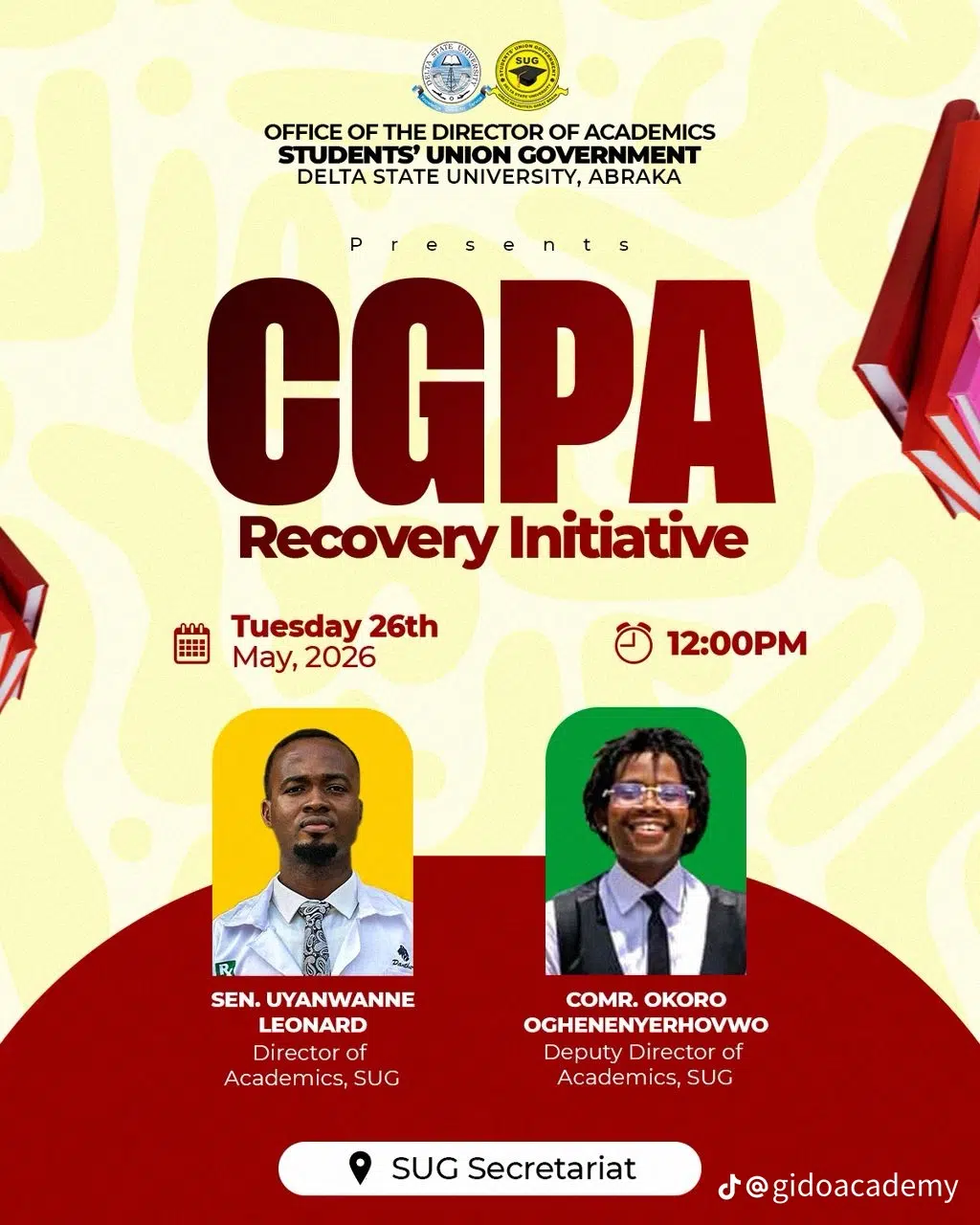
DELSU SUG Tackles Academic Decline with ‘CGPA Recovery Initiative’ for Junior Students
-

 Abraka Metro3 months ago
Rising House Rents Put Pressure on DELSU Students in Abraka
-

 Abraka Metro2 months ago
Elozino Ogege: Lecturers React As Court Sentences Killers Of DELSU First-Class Student To Death
-
 Education3 months ago
Challenges Persist at DELSU Agricultural Farm Despite Student Training
-

 Trending News3 months ago
Abraka Residents Advocate Entrepreneurship, Warn Against Gambling Amid Economic Hardship


